Home Page, JTM News, Member News

Stories for Navigating the Waves of Change

How can journalists discern what stories are most useful for helping us navigate through turbulent times?

One way to decide is by understanding the roles people play in changing times. I recently described some key roles on the Seapoint Center leadership blog. In brief:

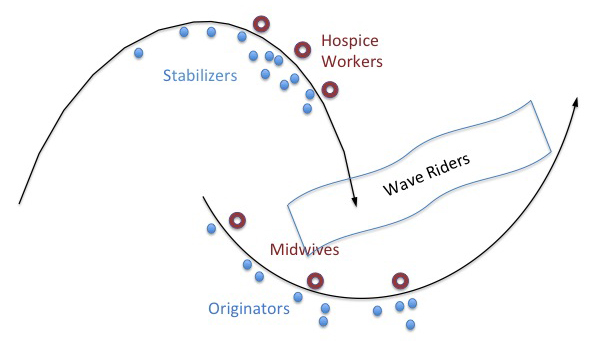
Stabilizers maintain the old systems and structures, for better and worse.

Originators experiment with a range of ideas, from the hair-brained to the brilliant.
 TwoLoopModel.jpg

Adapted from Berkana Institute’s Two Loops Theory of Change

These two roles are immersed in the shifting waves of change, caught up in two primary and conflicting forces: maintaining the old and inventing the new. Three other roles work with these forces:

Hospice workers help us to mourn what is dying.

Midwives help launch innovations.

Wave riders assist us in transitioning between old and new cultural narratives.

Journalists can help us appreciate the contributions of people performing each of these roles. They can honor legacies and illuminate values that still endure, even as they report on the shortcomings of failing institutions .  They can extend the reach of promising innovations, giving us hope for the future and more ability to embrace the unfamiliar.  Through telling these stories, journalists support hospice workers and midwives by bringing their work to a larger, and ideally more diverse audience.

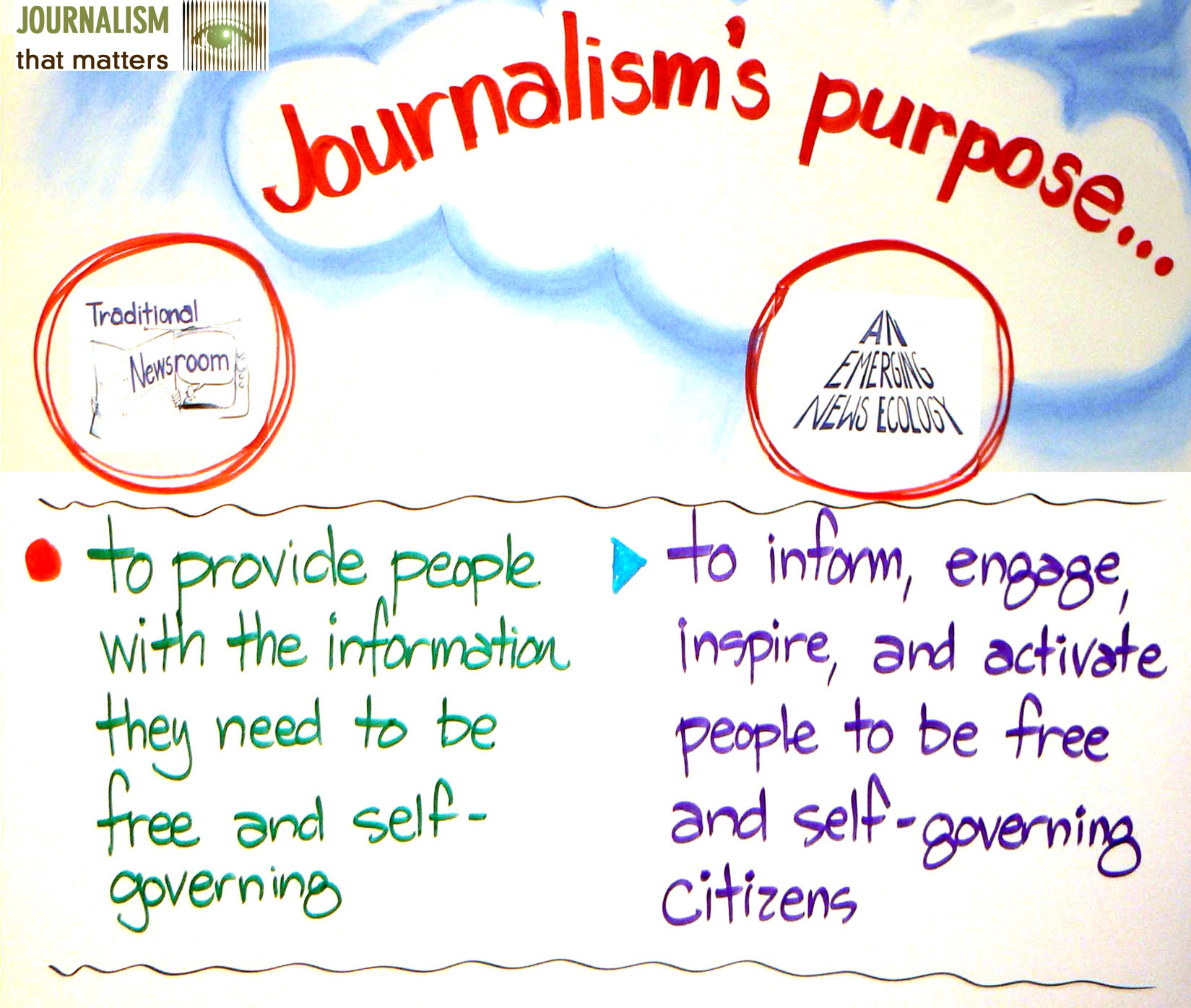
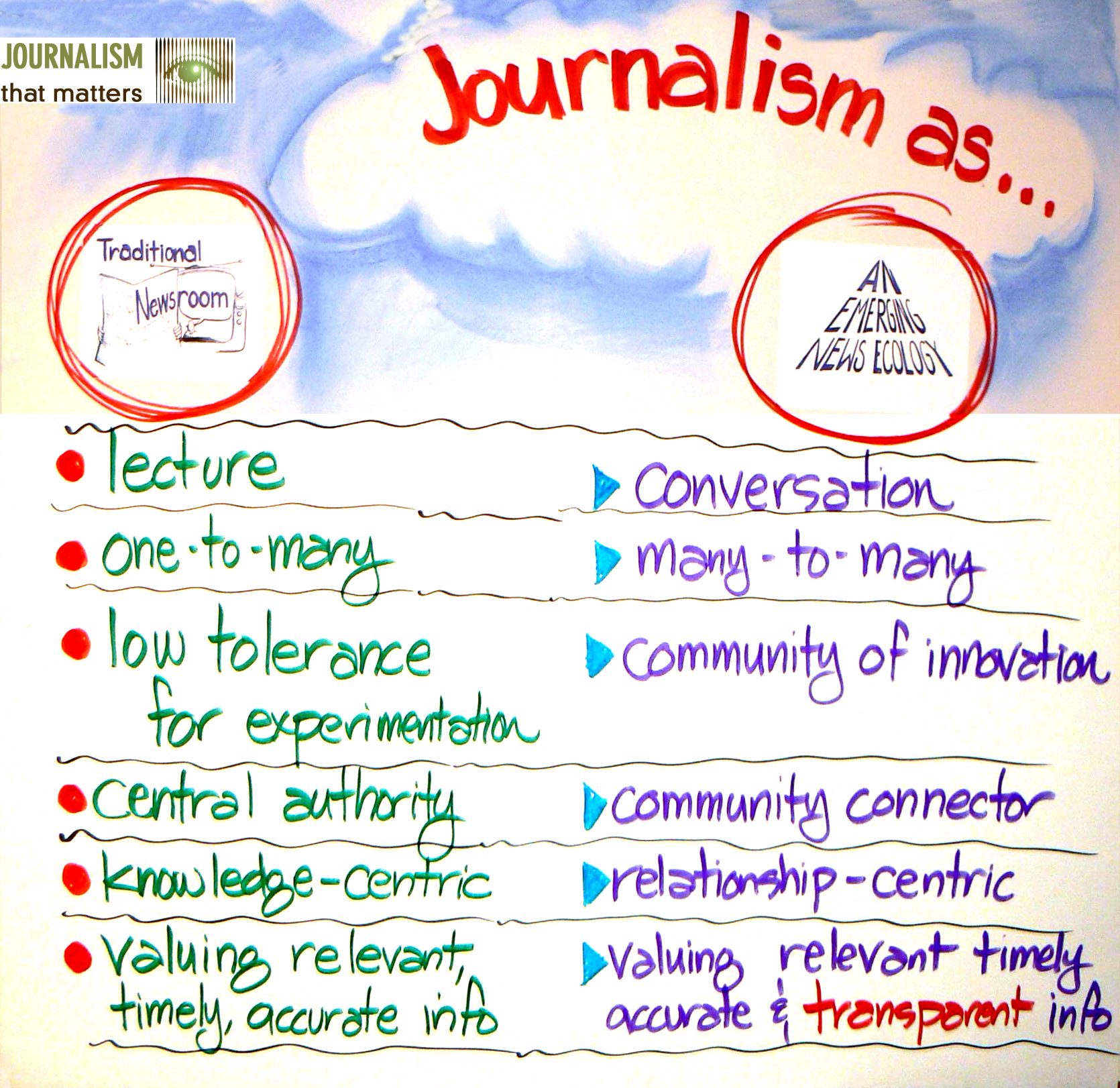
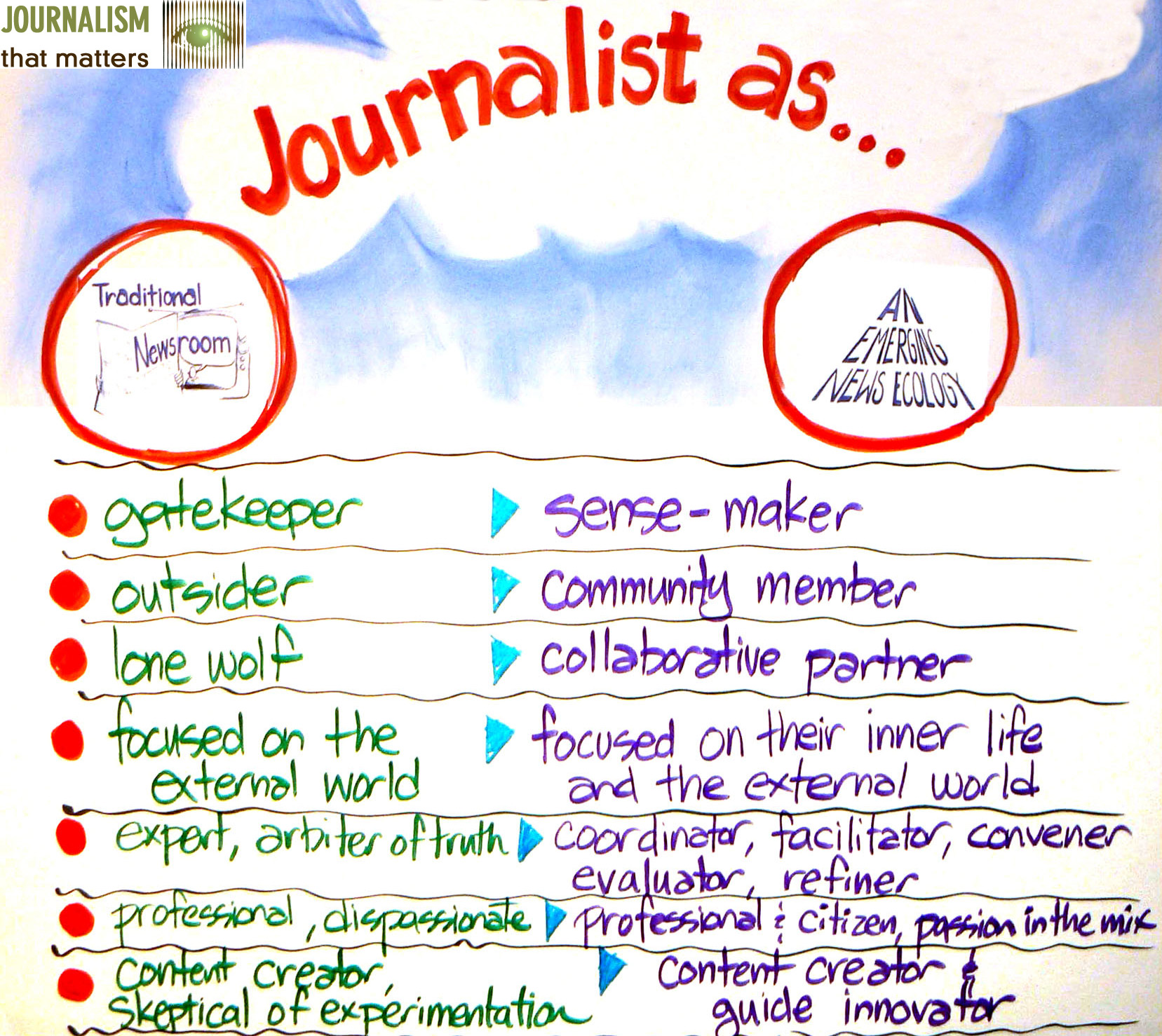
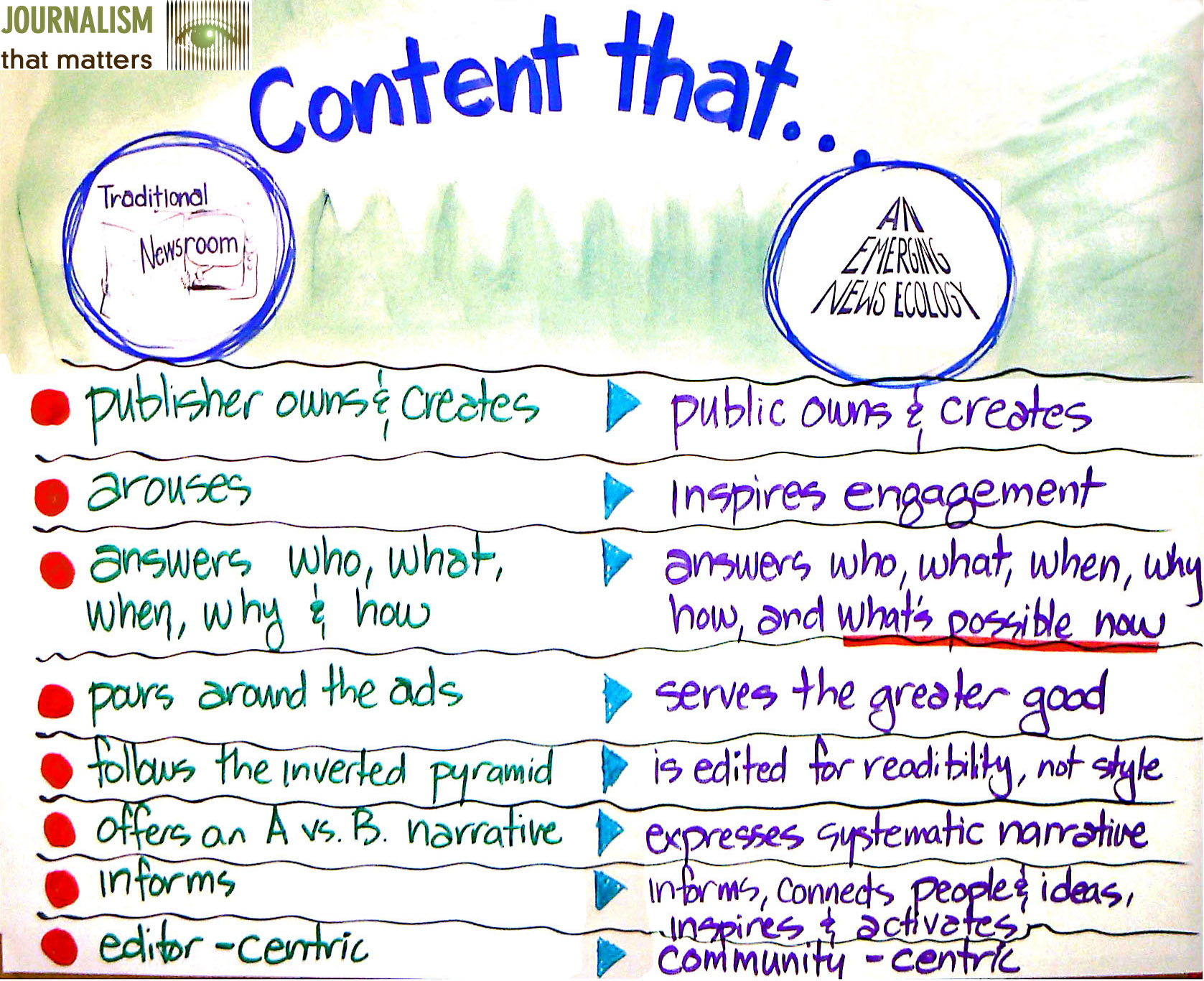
Perhaps most critical, journalists can help us through change by being wave riders themselves, making sense of the shifting narratives of our times through the stories they tell. For example, central to journalism’s traditional narrative is “giving voice to the voiceless” and “holding the powerful accountable”. While this narrative still informs journalism, through its convenings among the diverse players in the changing news and information ecosystem, JTM has tracked shifts in journalism’s narrative.

While by no means definitive, the table below is a snapshot of recent observations informed by conversations among JTM participants. I suspect that we are years from a well-functioning news and information ecosystem. Still, we are seeing glimpses of emerging patterns.

Journalism’s narrative…


Traditional Emerging


Journalism is about the public good. Journalism is still about the public good. And now it is entrepreneurial.
News organizations have a large influence on a community’s cultural narrative. Communities take primary responsibility for their cultural narrative. One strategy: embed journalists in the community.
News organizations are institutions that bring credibility. News organizations are of all shapes and sizes. Some bring credibility. Some bring heart. Collaborations bring us the best of both.
Independence brings stories focused on problems, winners/losers, and scarcity. Independence within interdependence brings engagement in diverse community that leads to stories focused on possibilities, adaptation, and abundance.


Unless it is an editorial, no advocacy. Period. Advocacy for a better world (e.g. better education, environment, health care, governance) without attachment to specific solutions.
Stories delivered via print, broadcast, and online. Stories delivered via print, broadcast, online, social media, hip-hop, video games, and other means.


By putting a name to what is changing, stories give us a chance to consider what endures from the past that is still relevant and what we wish to embrace that wasn’t possible before. Naming provides language for conversations about changing perspectives and their implications to the practice of journalism.  Where do you see yourself in these shifts? What do the changes mean for you and your work?

What if journalists characterized changing assumptions for education, healthcare, governance, or other systems they care about? How might that spark conversations about underlying beliefs and assumptions? How could it lead to greater understanding of the tensions among people in the system and in the process, cultivate greater understanding, compassion and creativity in changing times?

What are the stories you can tell that help us navigate through change?


*****


Changing Stories in Journalism

For more than a decade, JTM has tracked the narrative of journalism through the conversations it has hosted among diverse groups of people involved with news and information.

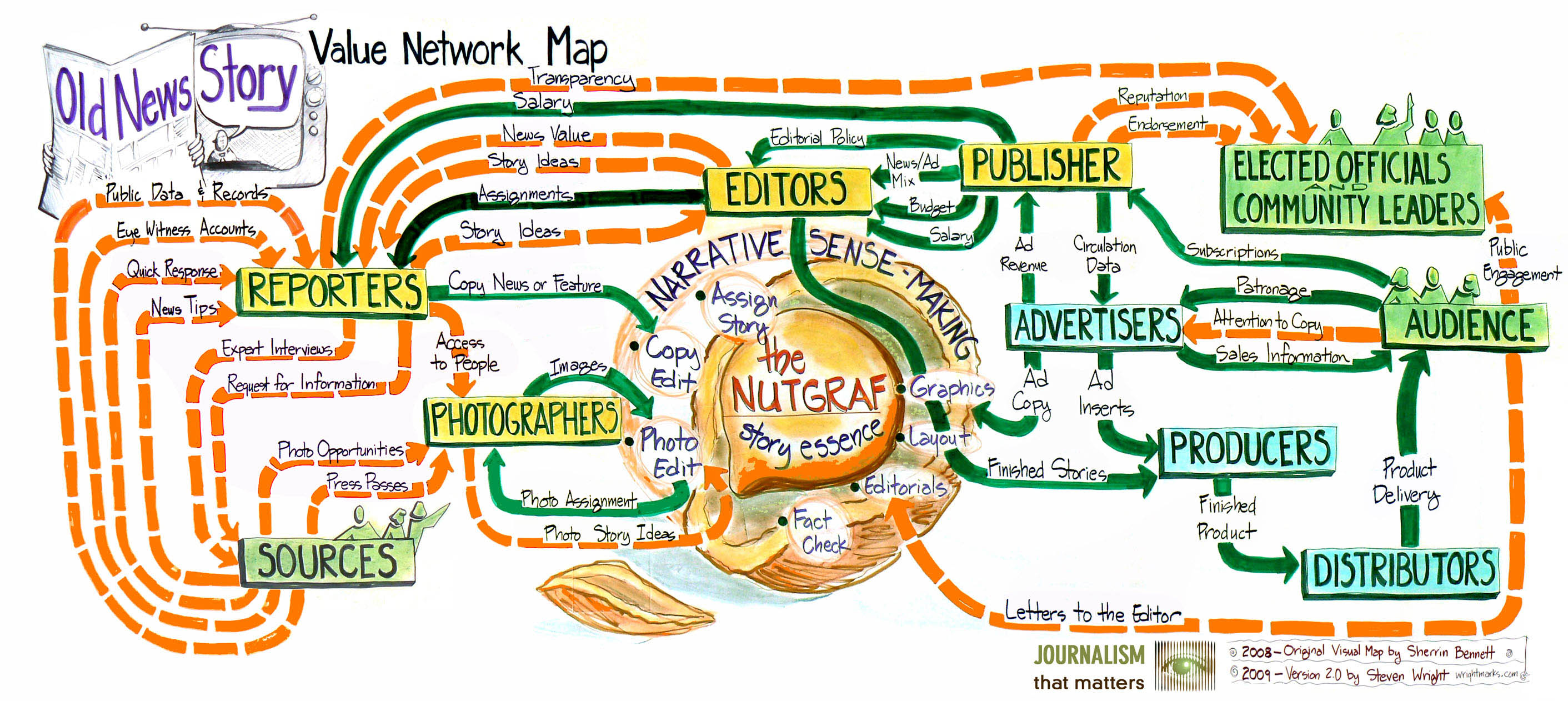
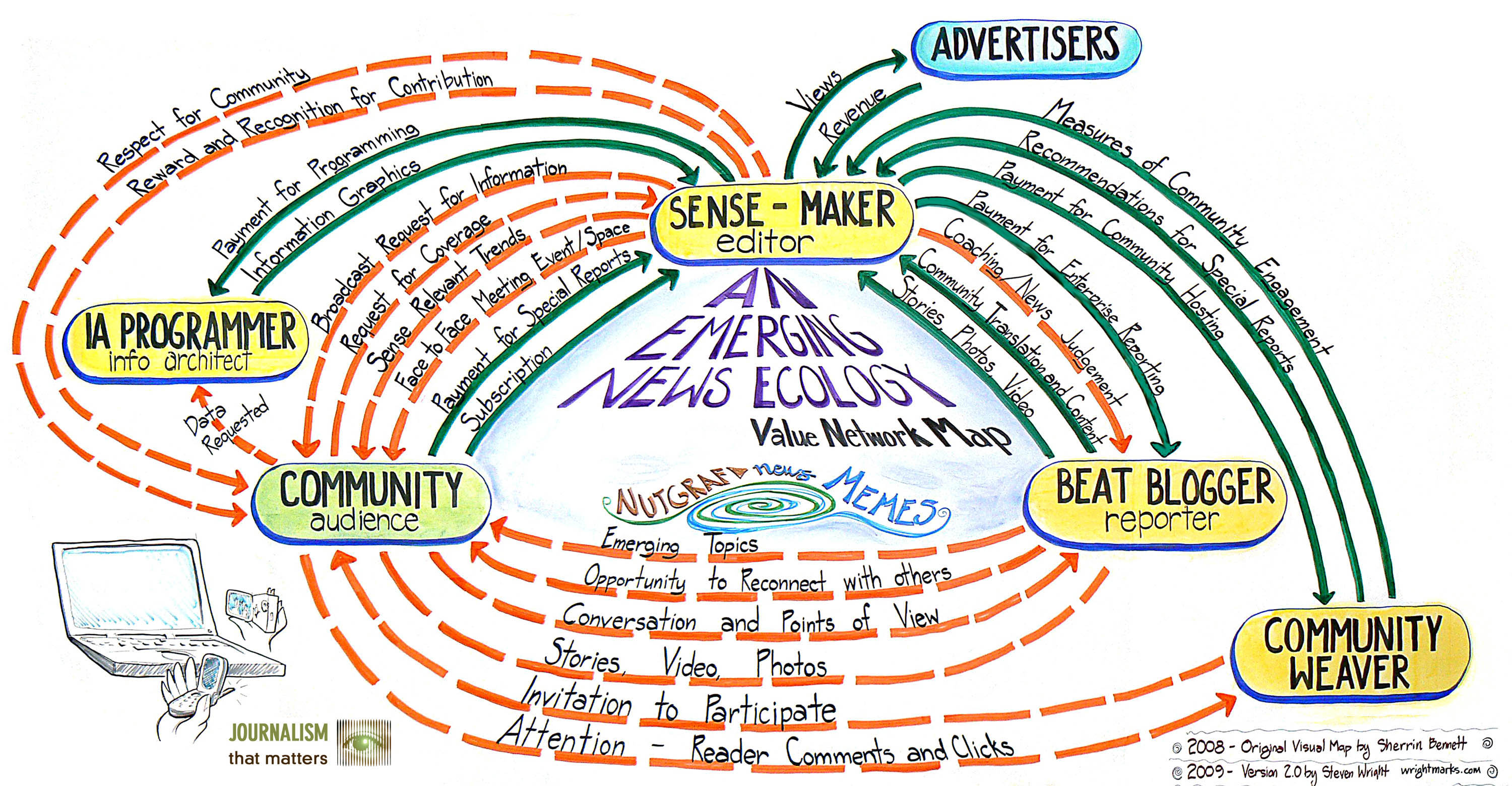
Created originally for NewsTools 2008 in Silicon Valley, the two value network maps below highlight shifts in key roles and exchanges in the news and information ecosystem.

old-v3-cropped-med_res.jpg


Emerging-Economy_cropped-med_res.jpg


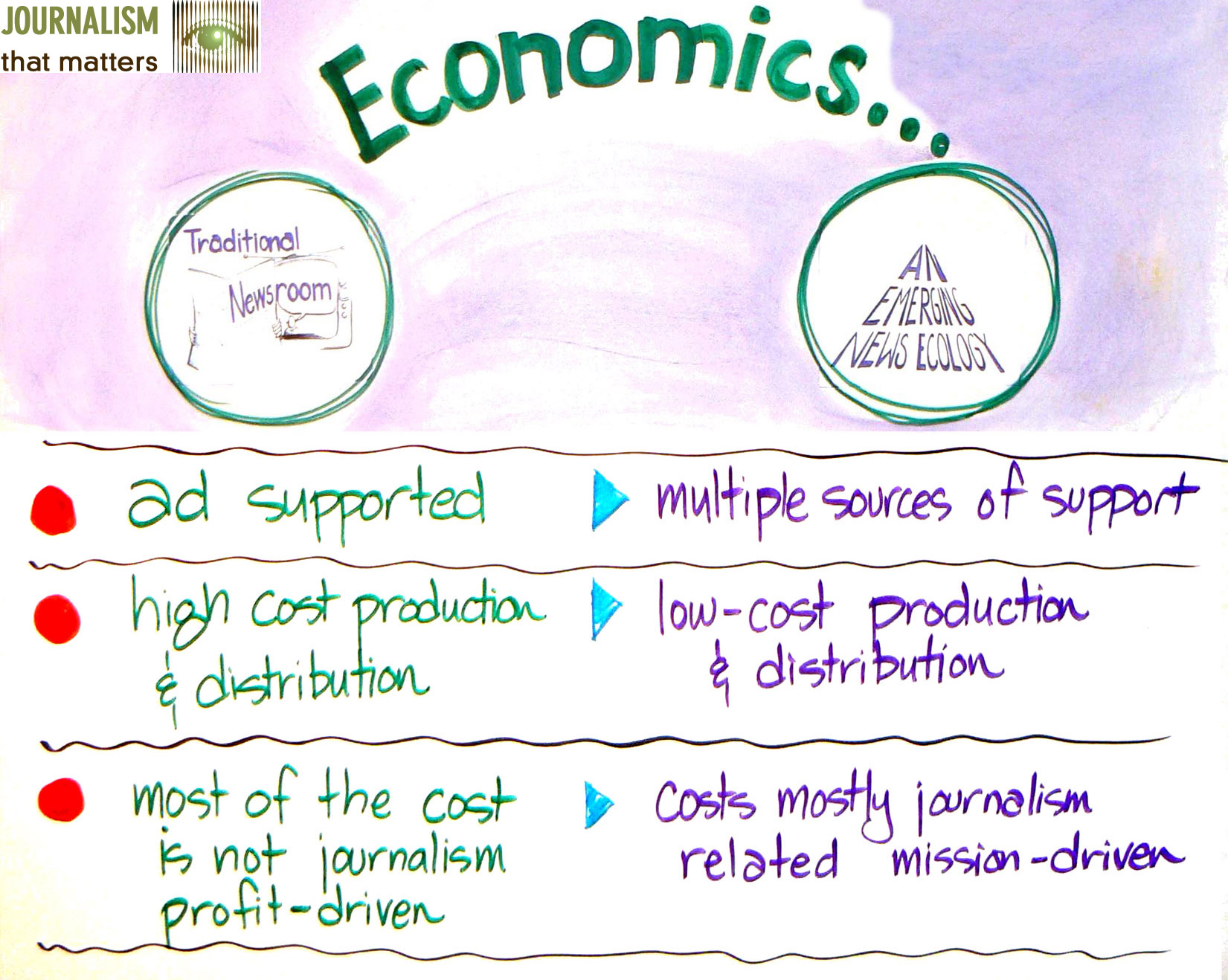
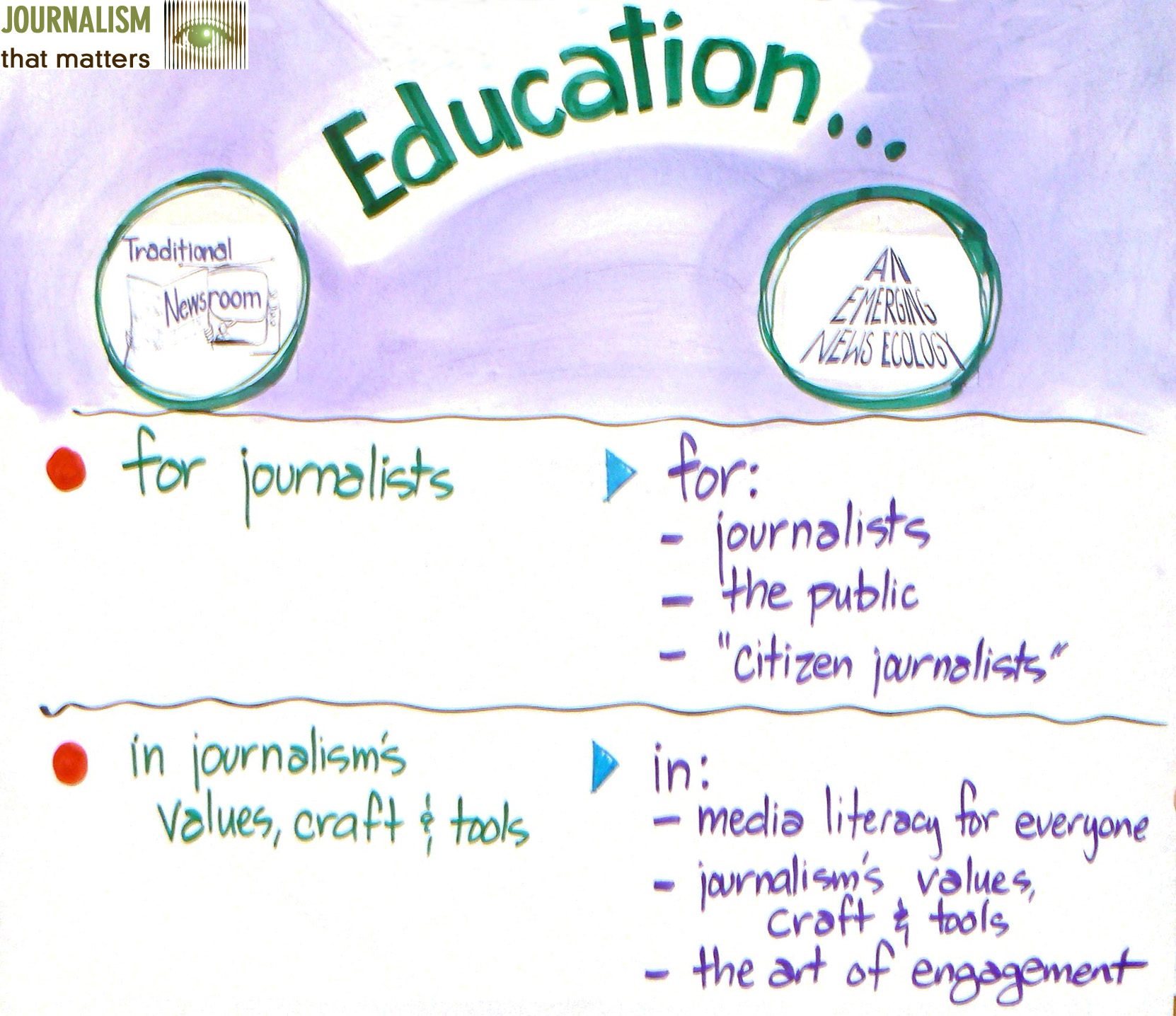
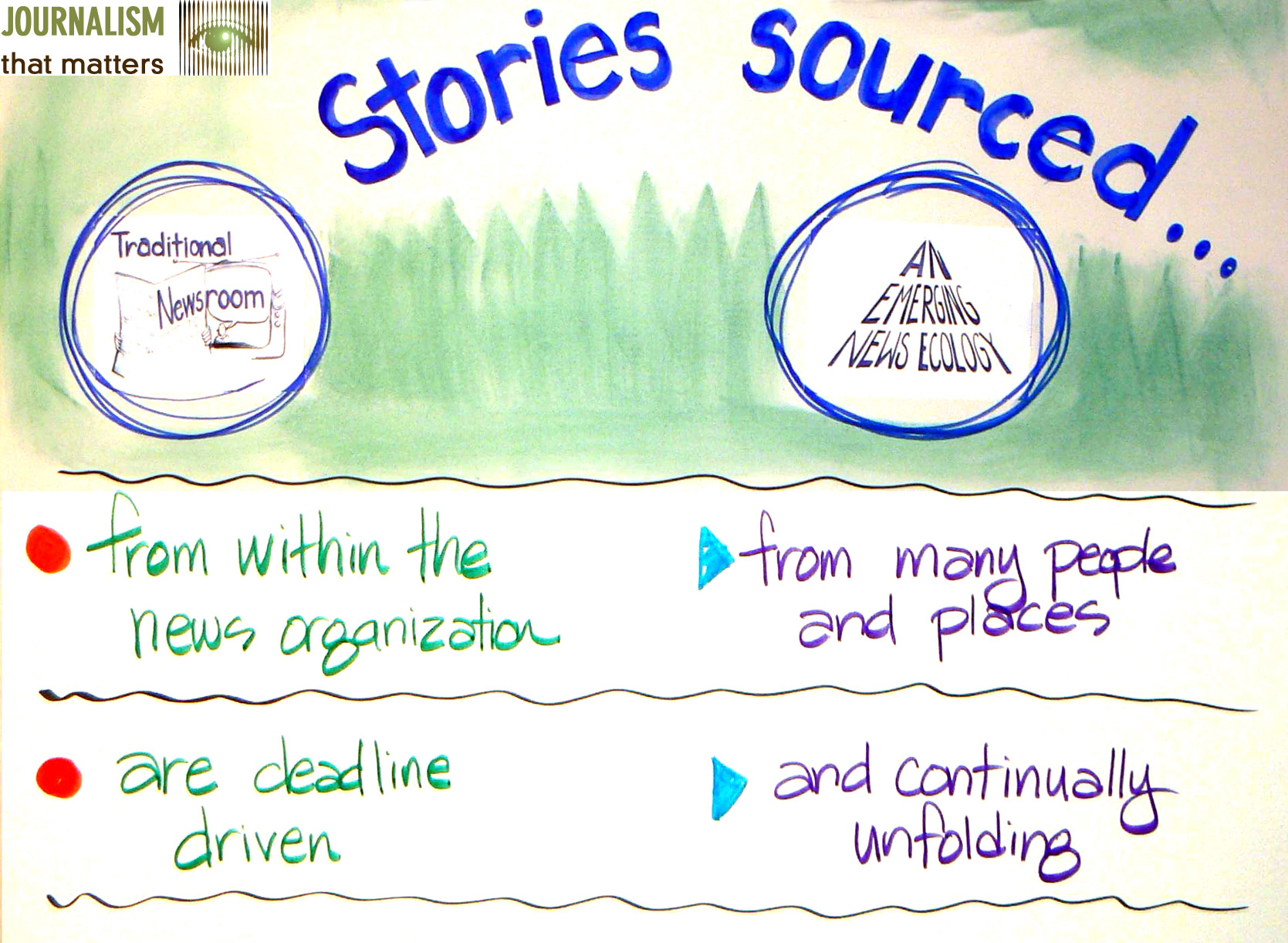
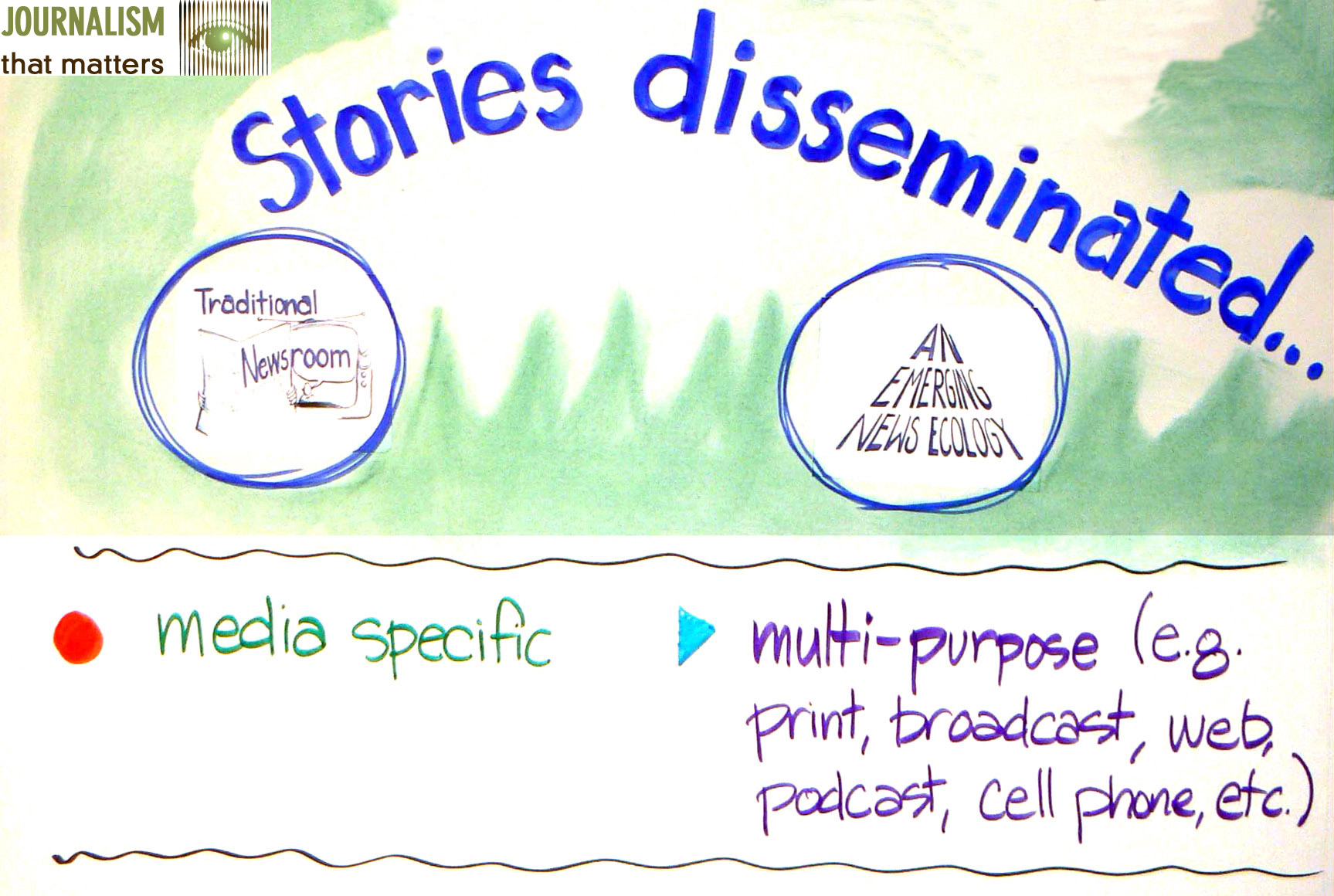
The charts of changing views that follow were compiled between 2006 and 2009. They still stimulate rich conversations about the changing story of journalism.
 

NewsEco-Journalism-purpose_cropped.jpg


NewsEco-Journalism-as_cropped.jpg

NewsEco-Journalist-as_cropped.jpg

NewsEco-Content-that_cropped.jpg

NewsEco-Economics_cropped.jpg

NewsEco-Education_cropped.jpg

NewsEco-Stories-sourced_cropped.jpg

NewsEco-Stories-disseminated_cropped.jpg

In the News, Journalism News, JTM News

Will FCC Chair Tom Wheeler Fight for Net Neutrality?

DSC_0112.jpg

Although often ignored and rarely understood, the FCC will be playing a powerful role in determining the future of the Internet following a court decision to strike down net neutrality. While experts in law and media are still grappling with what will come of the decision, it’s become clear that FCC Chairman Tom Wheeler has now been granted tremendous power.

Wired compared Wheeler to Frodo, and I guess the ring is the way the media-industrial-complex seeks to rule over the Internet. But clearly Wheeler is not a common hobbit of pure heart, and it’s unclear how his past life in both the television and tech industries will influence his responsibilities as chairman.

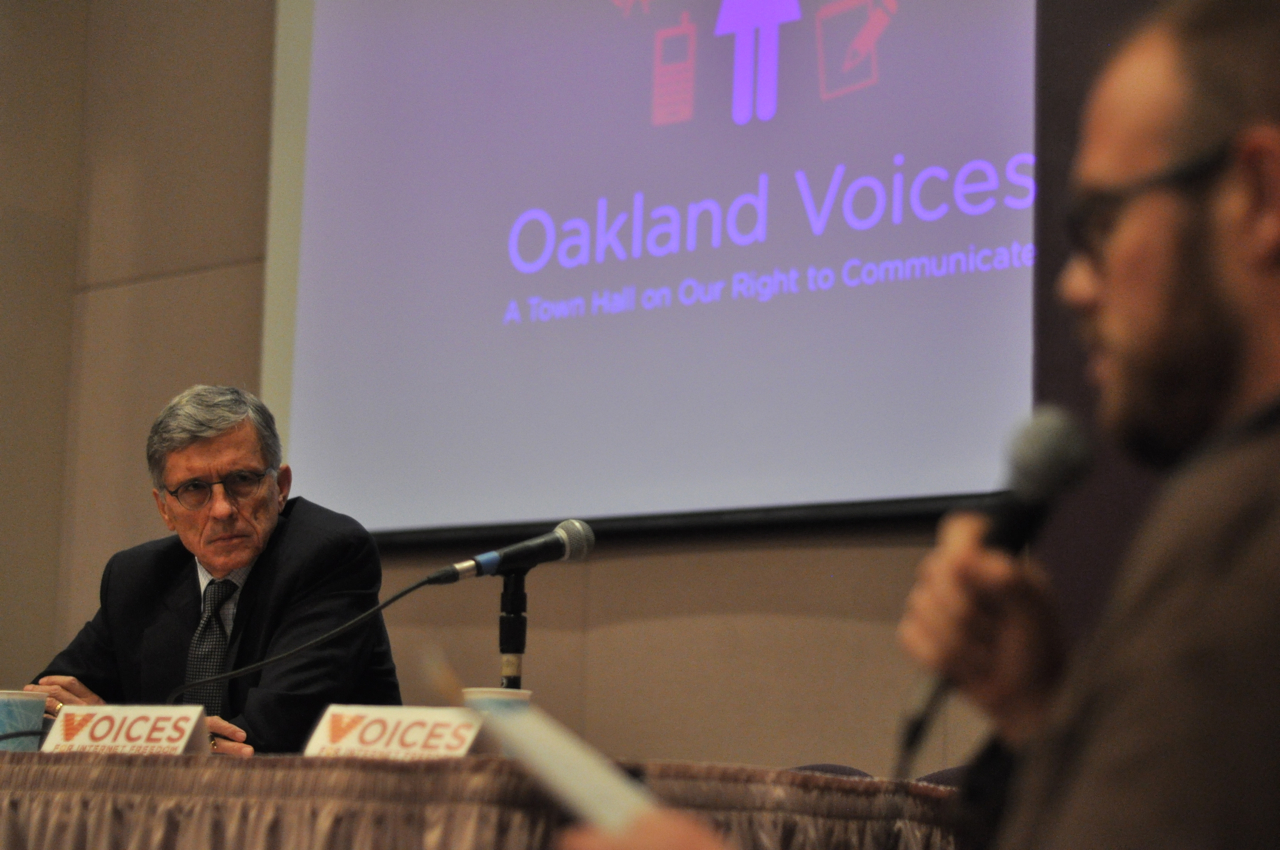
So who is Tom Wheeler, and how will he lead the FCC in transforming the rules that govern how people and corporations can use the Internet? No one knows for sure what will define Wheeler’s FCC, but the man may have revealed some clues earlier this month when he attended a town hall forum in Oakland, California.

Wheeler’s tenure with the FCC began last November, and the commission has met only twice since he became Chair. His wikipedia page is almost bare, and the only substantial biography of him available on the Internet can be found on the FCC’s own Web site. Although Wheeler’s significance wouldn’t be fully realized until the Court of Appeals would publish its ruling the following week, just his decision to attend the attend the January 9 forum showed promise.

The town hall was organized by Voices for Internet Freedom, a collaborative effort between Free Press and the Center for Media Justice, and it was the first town hall that Wheeler has joined as FCC Chairman. Next week the Illuminations Blog will examine how these groups came together and were able to convince Wheeler to participate.

“I was a typical Washington player,” Wheeler told the packed auditorium. “My goal now with my new job and my new responsibility is to learn by listening, is to take in the kinds of data points and information and passion that I heard tonight and say ‘OK, what are you going to do about it?’”

Based out of Oakland, with staff in both Chicago and New York, the Center for Media Justice works to “create conditions that strengthen movements for racial justice, economic equity, and human rights.” It’s executive director Malkia Cyril has worked closely with Free Press in the past and the two groups joined together in 2010 to create Voices for Internet Freedom to focus specifically on issues surrounding equitable access to the Web.

In bringing Chairman Wheeler to Oakland, the coalition was able to raise awareness to issues that are often ignored by the media’s coverage of the FCC. Issues such as the high cost of prison phone calls and threats to the nation’s universal lifeline program, which provides phone access to low-income residents, disproportionately impact people of color — and those living in poverty  — and garner far less coverage than net neutrality and media consolidation.

Most of the two-hour town hall event consisted of local residents giving testimony to Wheeler about their own issues that could benefit from FCC intervention. Organizers said it’s been more than five years since an FCC board member had participated in a town hall, and both local leaders and lesser-known residents quickly lined up to seize the chance to voice their grievances.

The most common issues people raised related directly to the needs of Oakland’s working class community. Several people called on Wheeler to expand the lifeline program to include wireless broadband access. The lifeline program already includes some cell phone providers but does not include access to wireless data. More than one individual also called on Wheeler to drop the requirement that applicants provide the last four-digits of their social security number to access the service.

The high cost of prison phone calls was another issue raised by more than one participant. One woman spoke to the $3,000 she spent in phone calls to stay in touch with her incarcerated son, and Lisa Rudman, the executive director of the public radio program Making Contact, described how these high phone rates hurt people on both sides of the prison’s walls.

Other major issues were raised during the testimony, including health concerns surrounding wireless technology, rampant media consolidation, the lack of media owners and managers who are people of color, and the dire need to maintain net neutrality. It became clear that the digital divide and obtaining reliable Internet access is still a problem in cities like Oakland.

“At this point in history, more than any other point in history, the networks that connect us are the networks that define us, and its not just our economics, it’s not just our commerce, it’s our culture, it’s our individual lives and that makes the job of the FCC incredibly important and I take it incredibly seriously,” said Wheeler. “I’d love to sit here and say ok, it’s all solved but I can’t do that and you wouldn’t believe me if I did anyway.”

But some say that that the FCC chair did just that when he posted a blog responding to the Court of Appeals decision.

“Now that the Court of Appeals has ruled on the Open Internet (Net Neutrality) Order upholding the Commission’s authority to act under Section 706, I want to provide a further insight into my oft-repeated statement that I am pro-open Internet,” said Wheeler. “The key message is that the FCC has the authority — and has the responsibility — to regulate the activities of broadband networks.”

Although it does appear that Wheeler’s correct that the law still does allow the FCC the authority to regulate the Internet, he neglects to point out that the court explicitly rejected the way in which his predecessor Julius Genachowski sought to create such regulation. More importantly, it’s widely believed that the FCC rules governing net neutrality were actually designed to fail a legal challenge.

Still, the fact that Wheeler took part in the Oakland town hall is a clear indication that he is at least willing to listen to the needs of the community and his responses to their concerns suggest that his alliance may be to the American people and not the corporations he once served.

“The idea of lifeline for broadband is a legitimate concept and we’ve got to figure out how to make it work,” said Wheeler. He also vowed to continue the fight for regulations governing the cost of prison phone calls.

“There has been a set of values and the relationship between consumers and the networks that serve them and those values are not just going to go poof because someone has come up with a new technology for delivering those messages,” said Wheeler. “Those are the challenges that we’re going to be fighting.”

But it’s important to note that although Wheeler has clearly positioned himself as an advocate of Internet freedom and net neutrality, it is not just the free flow of ideas that he is professing should be protected but the market itself.

“How do you make sure that the values that we’ve come to expect, the kind of things that you were talking about today, apply going forward in the new network technology on behalf of consumers, on behalf of competition, on behalf of the kinds of things that I was hearing about tonight,” said Wheeler. “Why in the world is anybody ever going to subscribe to your service if they can’t make a 911 call? Why in the world is anybody going to ever subscribe to your service if there’s some kind’ve preferential service given to somebody else? Why is somebody ever going to subscribe to your service if they can’t inter-connect with other networks?”

Illuminations Blog, JTM News

The Weekly Illumination — Issue 15

Welcome to the the Weekly Illumination, a JTM newsletter offering a quick look at the week in journalism with a focus on what’s working in today’s news ecology. In this week’s Illumination we’ll explore the New York Times redesign, new tools for social networks to do reporting and offer a few of the best tips posted online this week.

New York Times New Look

The New York Times redesign has been described as subtle, and it’s true that I can barely notice the differences on the home page, but the minimal design of the article pages feels like a major departure to me.

Jeff Jarvis offered a mostly glowing review of the redesign for The Guardian, but suggests that the Times should’ve taken a personalized approach to curating the news. He also teased that the Guardian is deep into its own redesign.

But the big news is the introduction of native advertising, a move that left Andrew Sullivan comparing the Times to Buzzfeed. The first campaign the New York Times launched is one with Dell computers, and the newspaper went out of its way to highlight its sponsored status. In fact, an article in Adweek suggests that the Times may have gone too far in labeling the content as advertising.

“If, at the end of the day (and whether publishers and advertisers want to admit it or not), native advertising is meant to trick readers into thinking it’s actual editorial content, the Times’ overt labeling might seem to defeat the purpose,” writes Lucia Moses for Adweek.

Tricks of the Trade

News Tools

The Knightlab has launched Untangled, a set of tools to help reporters analyze social networks. The service lists a number of tools to examine how people are connected to each other and is curating stories produced using its tools. Another useful tool to help journalists navigate social networks is Pipl, which can be used to help verify the identity of account owners.

***

When JTM-alum David Cohn launched Spot.us crowdfunding hadn’t entered the lexicon and the best way he had to describe his new start-up was to call it Kiva for journalists. A few years later Kickstarter was raising millions to finance blockbuster video games and movies and Spot.us was on life support. Now the Guardian is launching a new crowdfunding endeavor for journalism called Contributoria and Cohn, who is now at Cir.ca, has tweeted his interest in the project.

Odds and ends & odd ends

Another look at First Look

First Look media, the company financed by Pierre Omidyar has announced its this past week. Bill Gannon, who has worked as the editor of Entertainment Weekly and taught at the UC Berkeley Graduate School of Journalism, participated in an interview with Jay Rosen, another member of the First Look team, to discuss the role Gannon envisions holding at the new company.

Glenn Greenwald also shared new details about his own involvement with First Look Media after one of his supporters sent an e-mail expressing concern about the new project.

Jobs of the week

Billionaires, a Bloomberg publication, is looking for an editor.

St. Cloud State University in Minnesota is now hiring someone to chair its new media convergence department and to teach multimedia journalism.

NBC News has an opening in its investigative unit for a supervising producer.

KJRH-TV in Tulsa, Oklahoma is looking for a multimedia journalist to join its investigative unit.

The Missouri School of Journalism is seeking an assistant professor to teach magazine writing on a temporary basis.

The deadline to apply for a Nieman Fellowship is January 31.

JTM is looking for freelancers to write about successful journalism initiatives and is paying up to $250 per story.

***

The Illumination is a curated collection of stories about journalism innovation, notable job opportunities, grants and updates about Journalism that Matters. It is distributed to e-mail subscribers, through the JTM Google Group, and posted to the Illuminations blog.

Illuminations Blog, JTM News

Hack the Hood with Oakland Local

On Friday, January 10 at noon Pacific time, Journalism that Matters will host a hangout with Susan Mernit to discuss Hack the Hood and Oakland Local’s other initiatives.

If a news outlet is going to serve the community it must serve the community. Though the sentiment seems obvious — and is true by definition— it is a principle that Susan Mernit and her team at Oakland Local have truly taken to heart.10448905056_8683371a6b_b

Since its 2009 launch, Oakland Local has published a wealth of original reporting while aggregating additional content and showcasing reader submissions. The site is one of two major hyperlocal news sites that serve the 400,000-person city located six miles east of San Francisco.

The other, Oakland North, is one of three hyperlocal sites run by the Berkeley Graduate School of Journalism and focuses on the primarily wealthier neighborhoods in the northern part of the city. But Oakland Local has from inception sought to tell stories from every community including the poorer neighborhoods in East and West Oakland where the rate of crime continues to haunt the city’s reputation to outsiders.

The reporters and other contributors to the site comprise a diverse group that strives to be representative of a city where one quarter of its inhabitants are black, another quarter are white and another quarter latino. This diversity is demonstrated by the breadth of stories featured on the site. The remaining quarter is comprised of people identifying as Asian and those of mixed-race backgrounds, according to the 2010 census.

4894096506_1808dfce0e_bFrom coverage of the city council meeting, to the violence in the streets, to the rampant gentrification caused by the newest tech boom that’s pricing thousands of people out of San Francisco, Oakland Local seeks to tell as many stories from as many perspectives as possible.
But the people behind Oakland Local are doing more than telling stories. After establishing themselves as a news outlet, they began exploring how they could further serve their community.

“What can we do to help people in Oakland get jobs and get better jobs? What do we know that can support economic development?” asked Mernit at the time.

The answer turned out to be Hack the hood, a partnership between Oakland Local, The Center for Media Change, and United Roots Oakland. The program trains low income youth in multimedia and other tech skills who then apply that training to build web sites for local business and nonprofits in their community.

“The most important purpose of the project is to help the kids get skills,” said Mernit. “Most of the kids we dealt with had no soft skills. They didn’t understand how to look someone in the eye and shake their hand. They never had a job where they had to do that.”

9677009438_c9de1d12dd_bNot only do the students learn these highly marketable skills, but the program also introduces the youth to people working in the industry. Some of the students even had a chance to meet a Facebook employee from East Oakland.

For young people whose only exposure to real economic success are stories of the drug dealers, pimps, rappers and ball players from their neighborhood, I’d imagine that meeting someone from their neighborhood who is making enough from a legitimate career in order to thrive in the Bay Area could be quite inspiring.

“I think that the people in tech who responded to our requests for help really do understand the process of digital inclusion,” said Mernit. “People who work in tech in Oakland were really supportive of this project.”

The youth who participate are also paid for their efforts.

“We’re in a poor community,” said Mernit. “We respect their need for money— and their time.”

During the past summer the 18 students involved in the program created a total of 70 web sites and helped get these local merchants listed on social media.

Although this initiative would at first seem like an ingenious way to create new local advertisers who would otherwise have no reason to advertise on the web, it turned out that such an endeavor wasn’t actually practical.

“We thought about that,” said Mernit. “But we think local advertising is really broken so we haven’t expended efforts to get these local businesses up on Oakland Local. These businesses are pretty marginal.”

The site hasn’t given up on the advertising model, however, Oakland Local continues to run banner ads from several local businesses and the organization has a third site that may prove to be a solid revenue generator.

Oakland Local has partnered with the Kapor Center for Social Impact to create Live Work Oakland, a new site focused on the city’s burgeoning tech industry. The site includes technology-related news and prominently features a map of tech-related initiatives based out of Oakland along with a directory of the organizations included on the map.

In addition to that site, Oakland Local also has a program that combines in-depth reporting on Oakland schools with a variety of student-driven storytelling.

“A lot of it is driven by trying to find a sustainable business model,” said Mernit. “There’s just a giant self-limiting factor in trying to grow the ad base.”

But with so many projects linked together, Oakland Local hopes to become increasingly attractive to advertisers as it puts focus on expanding that revenue stream in the new year.

“We haven’t started to do that yet at all,” said Mernit. “That’s what we have to do toward the end of Q1. We’re still very much in the planning stage with all of that.”

***

On Friday, January 10 at noon Pacific time, Journalism that Matters will host a hangout with Susan Mernit to discuss Hack the Hood and Oakland Local’s other initiatives.

Disclosure: I have previously contributed stories to both Oakland Local and Oakland North.

Illuminations Blog, JTM News

The Weekly Illumination — Issue 14

Welcome to the the Weekly Illumination, a JTM newsletter offering a quick look at the week in journalism with a focus on what’s working in today’s news ecology. In this week’s Illumination we’ll look back at 2013 and forward to the new year, we’ll share some tips and job opportunities along the way.

Illuminations Hangout Series

JTM is launching a new series focusing on the work of our alum that will feature a weekly story alongside a Google Hangout beginning this Friday, January 10 at noon Pacific Time. Our first installment of the series will look at Oakland Local and their Hack the Hood initiative which teaches Oakland youth highly marketable digital skills. The accompanying Hangout will feature Susan Mernit, the Executive Director and Editor/Publisher of Oakland Local. Please join us to find out how this sustainable hyperlocal site has creatively approached numerous challenges in order to make things work for more than four years.

Tricks of the Trade

Looking back

With the door slamming shut on 2013, many sites and news organizations looked back on their accomplishments over the past year. Here are a few of our favorites:

Looking forward

The new year is symbolically a time for new beginnings and that metaphor is often embraced by companies looking to launch a new product or design. Kara Swisher and Walt Mossberg, who previously ran AllThingsD, launched ReCode with investment from NBCUniversal News Group and Windsor Media, and the New York Times plans to roll out its new design on Wednesday. It seems part of the motivation behind the new design is to incorporate native advertising; I don’t think anyone a year ago imagined the New York Times would be about to begin running sponsored stories on its site.

Over at 10,000 words, Angela Washeck shares her vision for the ten things she’d like to see happen in the journalism industry during 2014. And in a similar vein, Jeff Jarvis shares his perspective on what’s possible for TV news in the new year.

A brave new world

But underneath the cautiously rosy forecasts for the year ahead remain the stories that reveal how elements of our planet continue to resemble Huxley’s dystopian vision. Not only in regards to the revelations unveiled by Edward Snowden but also at a more pedestrian level.

In Oregon, a student media advisor at OSU was reprimanded for filing a public records request in preparation for an exercise with her students and a newspaper in Tennessee ran a story about a phallic-shaped tree branch and then blurred out the branch in the accompanying photo.09089df4714debda46c60783a08feeb5

While it’s legal for a private citizen to attach a camera to a remote control airplane, the same activity may be illegal for a news organization, reports Jeremy Barr for Poynter after the Spokesman-Review published a video one of their reporters shot with his own gear on his own time. Meanwhile the future journalism project is reporting that in Saudi Arabia posting on You Tube may soon require a state-issued license.

By now everyone knows how Justine Sacco, a PR professional, destroyed her career by posting a shockingly naive racist tweet before boarding a plane to Africa, but it turns out that JTM-alum David Cohn was the first person to respond to her on Twitter. In a recent post Cohn reflects on how he somehow became the initial voice in what became a social media mob.

Sometime recently the team at Conan O’Brien discovered that anchors across America were pulling from the same script and began assembling montage’s that are both hilarious and unnerving. In the most recent example, reporters from across the country voice the same words over and over again: “It’s okay; you can admit it if you bought an item or two or ten for yourself.”

As Poynter reveals, that script actually originated with a syndication service called CNN Newsource. But the realization that this copy is being regurgitated without bothering to rewrite the material or check its facts is hardly comforting.

Odds & ends and odd ends

Jobs of the week

JTM is looking for freelancers to write about successful journalism initiatives and is paying up to $250 per story.

Did you produce a notable work of investigative reporting this year? If so be sure to enter IRE’s annual contest.

CSU Los Angeles has an opening for a tenure-track assistant professor of journalism.

The University of Miami is looking for a visiting professor to work with students on documentary projects aimed at increasing the visibility of the problems facing members of Europe’s Roma communities.

Seattle’s Neighborhood House is hiring a communications coordinator. 

Syracuse University is looking to hire a tenure-track assistant professor of journalism with broadcast and digital journalism experience.

The Freelancers Union is seeking a senior writer.

UrbanDaddy is hiring a freelance writer to review bars and restaurants in Charlotte, North Carolina.