Home Page, JTM News

Journalism for Navigating Uncertainty: The Possibility Principle

Journalism can help us envision and move towards a world that works for all.

Journalists have a unique role as storytellers, influencing the cultural narrative that weaves society together. Through my work in organizations, I know that when the stories people tell about the organization change, so does the culture.  The same holds true on the scale of a society.
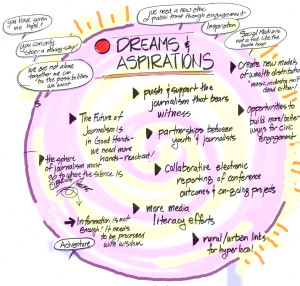
JTMNW-Jan2010-Day4-1_Conf-Close-outcomes-cropPossibility-oriented stories generate new options. Research on the relationship between positive image and positive action by David Cooperrider, Case Western Reserve University professor of Social Entrepreneurship shows that we create what we can imagine.  Uncovering possibilities feeds our imagination, which is key to journalism that informs and also engages, inspires, and activates.

Though much of our current narrative is filled with stories that increase polarization, journalism educators and professional journalists are re-thinking dualistic — us versus them — models of storytelling.  Even investigative journalism, with its gotcha reputation, is increasingly including solutions.  InvestigateWest, a nonprofit investigative news organization born when the Seattle Post-Intelligencer closed, includes solutions as part of its approach.  Their groundbreaking story on the hazards of chemotherapy exposure for health care workers resulted in passing two laws improving worker safety in Washington state.  According to Rita Hibbard, executive director at the time, what made the difference were the possible solutions in the story.

This story demonstrates that even when the situation seems dire, other storylines are possible. In fact, conflict and struggle placed in a larger context become challenges to overcome rather than reasons to despair. They spark creativity and innovation.

Possibility-oriented storytelling brings journalism into the heart of community life, and supports a vibrant democracy. J-Lab executive director, Jan Schaffer, highlighted several examples in a Nieman Journalism Lab article.  Journalism That Matters gave the idea a practical twist by building on the traditional journalistic questions of who, what, when, where, why, and how, suggesting a sixth “w”: What’s possible now?

News organizations have emerged that are committed to a possibility-oriented perspective.  YES! Magazine has been at it since 1996.  Axiom News is of a similar age.  Both are growing. What’s Good 206 involves youth in telling stories of compassion and success.  David Bornstein’s weekly Fixes column in the New York Times explores solutions to major social problems.  And Bornstein’s newly formed Solutions Journalism Network is committed to rigorous and compelling reporting about responses to social problems.

Tips for Telling Possibility-oriented Stories

I offer a few pointers gathered from those who have been at it for a while:

  • Turn a problem into a possibility by asking: What might it look like if things were working?
  • Ask questions to discover the best of what is, to imagine what’s possible, to uncover ideas, and to spark action.
  • Cover what’s already happening to improve a situation.
  • Provide “handles” for audience to learn more or to get involved, for example, pointing to resources and organizations.
  • Report on new ways that are struggling to be born with the same attention and rigor as on what is dying.
  • Tell stories that present alternatives to dominant beliefs about “how things are”.
  • Turn victims into protagonists, for example, by following a story those affected make sense of their experience.
  • Make the system visible.  A vs. B stories miss the complexity of interactions involved.  Making nuances that transcend sides visible can bring about unlikely partnerships.
  • Invite audience to offer ideas about what they see as possible and what actions they will take to make it so.

Possibility-oriented storytelling feeds a cultural narrative that helps us to navigate uncertainty by focusing attention on creative ways forward.  Another critical complement for equipping us to be free and self-governing rests in engaging the diversity of people who care about an issue. The next post sheds some light on engagement.

Got something to contribute?

A tip? An article? I’ve started gathering resources. Please add by

Unless you explicitly request otherwise, I will post comments sent via any of the above in the comment space on this page.

Follow up on last week’s post, An Expanded Purpose for Journalism

Email was still the primary vehicle of choice for responding, though Facebook also brought some comments.  Jane Stevens, Founder, editor of ACEsTooHigh.com, offered the example of WellCommons, Lawrence Journal-World’s local social journalism health site.  I’ll be saying more about the award-winning WellCommons in the next post in this series.  So stay tuned!

=======

Illuminations Blog, JTM News

The Weekly Illumination — Issue 4

Welcome to the The Weekly Illumination, a JTM newsletter offering a quick look at the week in journalism with a focus on what’s working in today’s news ecology. The Illumination is a curated collection of stories about journalism innovation, notable job opportunities, grants and updates about Journalism that Matters.

The newsletter is distributed to e-mail subscribers, through the JTM Google Group, and posted to the Illuminations blog. In this week’s Illumination we’ll explore the opportunities in big data journalism, the federal shield law now headed to the Senate and the growing role of experimentation in the newsroom.

Proposed federal shield law headed to full senate

On Thursday, the Senate Judiciary Committee passed a bill that would give shield protections to some journalists subpoenaed in federal court. The bill, which is a compromise between the language urged by Sen. Charles Schumar and that of Sen. Dianne Feinstein, would protect journalists who have been employed as a journalist for at least a one-year period over the prior two decades. The law would also protect student journalists, and it would empower a judge to offer the protection to journalists who would otherwise not meet the new legal definition of a journalist. Although the bill offers more robust protections than previous attempts, it is still written to protect a class of people as opposed to the activity of producing journalism.

With the Federal government poised to define a journalist for the first time in history, the Digital Media Law Project at Harvard has announced a new research study to look at media credentialing practices across the country.

What does journalism that meets the needs of democracy look like?

In the second installment of her series on the purpose of journalism JTM Board Member Peggy Holman describes a holistic system in which journalism and engagement fully support each other to create action and inspire vision, which in turn generate new journalism.

The innovation explosion

In this week’s column, I wrote about how the news ecosystem could benefit by embracing the start-up culture’s commitment to radical experimentation. The purchase of the Washington Post by Jeff Bezos will also provide a financial cushion to give the Post room to perform these experiments, reports Ken Doctor for Nieman Lab.

The New York Daily News has announced it’s own efforts to foment innovation. The Daily News Innovation lab will invest and mentor a group of early-stage startups in a program similar to San Francisco’s Matter.

Prison prescribed to treat viral media

A new law in China threatens up to three years in prison if a dissident’s message goes viral. “Internet users who share false information that is defamatory or harms the national interest face up to three years in prison if their posts are viewed 5,000 times or forwarded 500 times,” reports GlobalVoices.

Big data is getting big

The stories found in data can be profound, and there is more public data available to journalists than ever before. But many journalists don’t have all the skills they need to make sense of the all of the data available. Poynter’s Anna Li shares her experiences completing a massive open online course that introduces some of these skills. The course is still available to review through the end of the month.

After completing that course, why not practice what you’ve learned by participating in the 311 data challenge. The $5,000 contest will be soon be announced on Kaggle.

For journalists looking who are looking to scrape data from the web but don’t know how to code, import.io might be just what you need, reports Sarah Marshall at journalism.co.uk.

Job(s) of the Week

The Spokesman-Review is looking for a reporter to cover Spokane City Hall.

USC Annenberg is now accepting applications for its health reporting fellowship, which is scheduled to take place in February.

Each week, The Illumination will include links to jobs, grants and fellowship opportunities. If you are hiring or know someone who is, send me an e-mail and I’ll gladly list it here. If you’re looking for a job, let me know what kind of work you are looking for and I’ll try to post anything I come across that could be a good fit.

Home Page, JTM News

An Expanded Purpose for Journalism

What does a re-vitalized, economically viable journalism that meets the needs of communities and democracies look like? 

Imagine a news organization that invites the public to become sources to “add context, depth, humanity, and relevance” to news stories.”  That’s what American Public media is doing through its Public Insight Network.  In Cleveland, Rita Andolsen left her news director job at WKYC-TV to become the station’s director of advocacy and community initiatives.  Now she hosts community conversations and looks for issues where this commercial station can ethically advocate on behalf of the community to improve the city and its neighborhoods. Or what about publishing a series making visible the widening economic and social gap between minorities and whites in the state and then convening statewide conversations to do something about it?  Laura Frank, executive director of the I-News Network in Colorado, led the way through “Losing Ground.”  (Crockett, 2013).

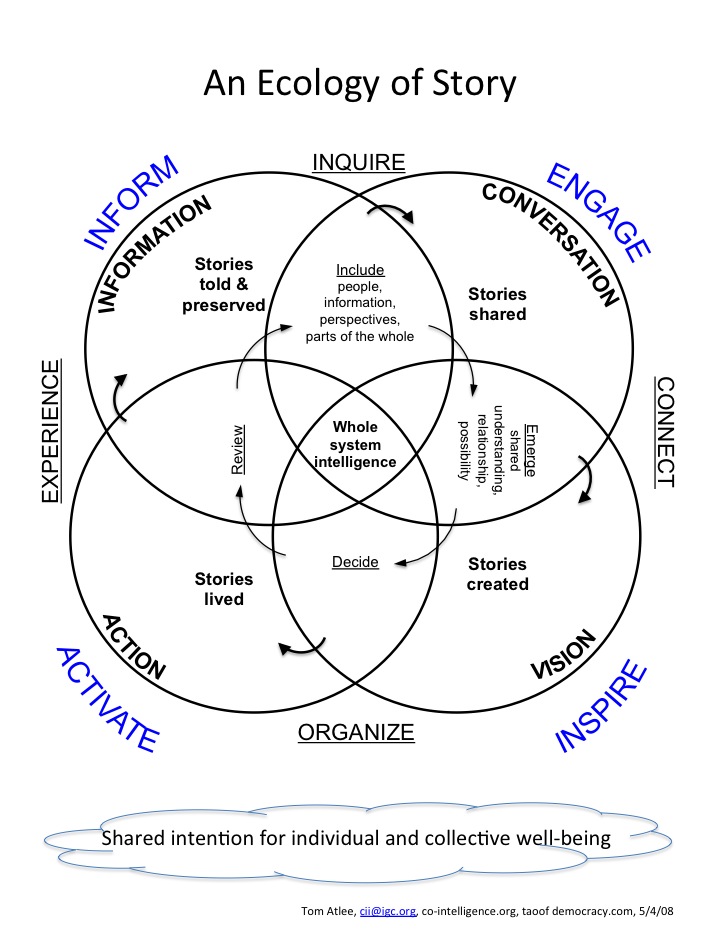
These examples of involving the public before, during, and after stories are published demonstrate an expanded purpose for journalism.  Not just informing, they also engage, inspire, and activate the public to create solutions. They help to recast attitudes of frustration, anger, and despair by calling forth resilience, curiosity and determination.  Journalism becomes a system that involves journalists and the public in shifting cultural narratives about what’s possible.

Drawn below as a framework for thinking holistically about journalism, telling the story is part of a system of interactions that help us to navigate through uncertainty.  This model emerged from a conversation that I had with Tom Atlee, founder of the Co-Intelligence Institute when he attended JTM’s 2008 New Pamphleteers conference in Minneapolis.

 Toms_Story_Model.jpg

A System of Purposes for Journalism, Tom Atlee


I spoke with Mike Fancher, retired executive editor of the Seattle Times, asking how such a model might have influenced the way the Times did its work.  He began by saying that the newspaper did all of these functions to some extent.  What excited him about this framework was that it treated journalism as a system.

He mentioned a story of a state crime lab that documented cases of innocent people going to jail and guilty ones going free because of system problems at the lab.  It was an important story that did its job of informing the public.  Yet nothing happened.  Mike reflected that traditionally, journalists don’t feel any obligation to help make something happen.

“With a more holistic approach, we probably would have built in elements that were move effective at motivating, mobilizing, inspiring and activating.”

This type of journalism could provide the public with the agency to work together to ask more complex questions about our prevailing cultural narratives such as: Who decides whether our systems – education, health care, governance — meet our needs? What do such systems look like? How do we create them?

Our society faces a dynamic tension.  An old media system that we understood, whether satisfied with it or not, is declining.  A new ecosystem filled with experiments and unanswered questions about how it operates and who and what to pay attention to, is emerging. Journalism organizations that work holistically with their communities are building authenticity and trust, moving beyond serving consumers to creating people and communities in action.

Such a journalism ecosystem requires changes in mindsets, skills, and activities.  Based on my work in organizational systems, I offer three keys in cultivating such a system: possibility-oriented storytelling, engaged constituencies, and diversity, in voices, forms, and funding. I’ll explore one of these each week over the next three weeks.


Got something to contribute?

A story?  A question?  A resource? A comment? In the spirit of JTM’s aspiration to be a go-to place for connecting people involved with the emerging news and information ecosystem, join in. You can:

Unless you explicitly request otherwise, I will post comments sent via any of the above in the comment space on this page.

Also, several of you asked if it was okay to share these posts.  Please do spread the word!


====

Follow up on last week’s post, What do we need from journalism?

Most respondants emailed me.  Some replied via Facebook, LinkedIn, or Google+.  Responses came from the U.S., the Netherlands, Korea, Brazil, Jordan, and Israel. Tom Atlee was inspired to post an article: Journalism to Energize Citizen Deliberative Democracy.  An Israeli journalist offered a story that I hope to share soon.  Wout-Jan Koridon suggested The Intelligent Optimist (formerly ODE Magazine) as an example.  My favorite comment came from Detroit-based information architect and Journalism That Matters alumni Mary Ann Chick Whiteside, who said: “Interesting idea to put hope as a benchmark of good journalism.” More of what you offered can be found here.


=======

Read the other posts in this series:

Illuminations Blog, JTM News

Bezos brings culture of experimentation to journalism

When Jeff Bezos announced his purchase of the Washington Post, the entire news industry turned its gaze to the Amazon founder with both uncertainty and excitement. It’s clear that the CEOs of today’s big tech companies are the closest thing this century has to the magnates of the industrial age, and their wealth represents one way to restore a robust news ecology.

The $250 million that Bezos spent on the Washington Post is less than 1% of his personal fortune so he can afford to fail repeatedly if success and sustainability don’t come immediately with Bezos at the helm.

Although Bezos and most of his very wealthy peers in the tech community may be new to the newspaper business, their experience in the tech industry may prove to be the most valuable asset in restoring the health of our news industry.

In the tech world, entrepreneurs are encouraged to feel comfortable with failure, as long as they learn from their mistakes. Nearly every successful tech company can point to numerous failures that preceded its success, and most of them can even point to new initiatives that have no chance.

That culture of risk and innovation is what has fueled inspiring new products and incredible fortunes. And while it’s clear that there are numerous failed examples for every success, there is usually no expectation to get it right the first time. Every product is gradually improved and refined, whether it be through software updates or the release of new hardware based on previous models.

The culture of journalism is historically governed by different values and expectations. Although the Web has made it possible to change a story after it has been published — whether to inject new information or to fix a mistake — a printing press is not quite so forgiving and neither are many readers or advertisers.

When reporting, it is absolutely critical to get every fact correct and to make certain that every quote is accurate and every name is spelled correctly. Any mistake — no matter how trivial — will undermine the integrity of the report and leave consumers questioning the report’s veracity. And while I haven’t worked on the business side of any news outlet, it seems that the drive to get it right the first time often carries beyond the editorial content.

Bezos isn’t afraid to take risks, and he can afford to make many mistakes on the way. The new owner visited the news room last week and told the staff that he conducted numerous experiments at Amazon before finding a profitable formula for the company. He will be conducting similar experiments at The Post, according to Len Downie, the vice president at large of the Washington Post, who appeared this week on CNN’s Reliable Sources.

Downie explained that Bezos wants to re-bundle the newspaper. The newspaper used to be how people found out what time a movie was playing, what was on sale at Macy’s and even where to apply for work or to identify an available apartment. Now the only thing a newspaper effectively delivers is news and commentary, which may not have been what newspaper subscribers were actually paying for. Bezos sees the tablet as the technology that can be leveraged to restore that role, said Downie.

Bezos isn’t the only tech millionaire to invest in journalism, although he certainly seems to have created the largest splash. Pierre Omidyar, eBay’s founder, launched the Honolulu Civil Beat in 2010. Seattle start-up veteran Jonathan Sposato partnered with two established tech reporters to launch GeekWire.

Craig Newmark of Craigslist has also invested his time and money into restoring a healthy news ecology. Last year he partnered with Poynter to host a symposium on journalism ethics, and the mission of his Web site CraigConnects is “using technology to give the voiceless a real voice and the powerless real power.”

I’m sure there are other successful people from the tech community who have invested in creating a sustainable future for journalism. If you know of any examples please share them in the comments below.

Illuminations Blog, JTM News

The Weekly Illumination — Issue 3

Welcome to the The Weekly Illumination, a JTM newsletter offering a quick look at the week in journalism with a focus on what’s working in today’s news ecology. The Illumination is a curated collection of stories about journalism innovation, notable job opportunities, grants and updates about Journalism that Matters.

The newsletter is distributed to e-mail subscribers, through the JTM Google Group, and posted to the Illuminations blog. In this week’s Illumination we’ll explore the future of journalism education, federal shield laws and the continuing evolution of social media.

“It is about male grooming, not Charles Manson.”

In what may be the best correction ever printed, the Sept. 1 edition of The New York Times writes, “An article last Sunday about the documentary maker Morgan Spurlock, who has a news film out on the boy band One Direction, misstated the subject of his 2012 movie ‘Mansome.’ It is about male grooming, not Charles Manson.”

What do we need from journalism?

JTM Board Member Peggy Holman published her first installment of a series she’s writing about the purpose of journalism, which is a culmination of the thirteen years she’s spent leading conversations with journalists through JTM and other avenues. Holman writes that journalism “engages, inspires, and activates us to be free and self-governing” in addition to informing us about our world.

TechCrunch Vs. The Awl

Elite Daily, a Web site that proclaims itself the “online destination for Generation Y,” has apparently ignited a feud between two other Web sites after TechCrunch published a superficial story about the portal in June. The next month, The Awl ran a scathing expose about Elite Daily, which included a link to the original story. TechCrunch then took down its story and has since published a new report that illuminates the shady practices uncovered by The Awl as well as Elite Daily’s response. Now the Awl has fired back with a new article under the headline “TechCrunch: Journalists or Startup Shills? You Decide.”

The right to report

Two U.S. journalists are facing legal peril this week for their reporting. Barrett Brown, a reporter who focuses on intelligence contractors, is facing up to 100 years in prison. The government alleges that he threatened an FBI agent, obstructed justice and linked to a chat room where unlawful credit card information was allegedly posted. “By seeking to put Brown in prison for linking to publicly-available, factual information, the U.S. government sends an ominous message to journalists who wish to act responsibly by substantiating their reporting,” writes CPJ Internet Advocacy Coordinator Geoff King. Now, a federal judge has ordered a gag order barring Brown and his attorneys from speaking about the case.

Joe Hosey, a veteran reporter who was covering a murder trial outside of Chicago, does not qualify for protections under the state shield law, ruled Gerald Kinney. Kinney said he will compel Hosey to disclose who released confidential police documents, but the Chicago SPJ chapter has called on the judge to reconsider.

The Future of the New York Times

New York Times CEO Mark Thompson spoke at the Reuters Institute for the Study of Journalism this week. The Nieman Lab has a summary of his remarks.

Job(s) of the Week

The International Center for Journalists is hiring a Knight Fellow to work in Nigeria for the next 10 months. “The Fellow will work with other ICFJ Fellows both in Nigeria and elsewhere in Africa,  as well as local and international technologists, to ensure that our journalist partners produce health stories that engage audiences.”

Each week, The Illumination will include links to jobs, grants and fellowship opportunities. If you are hiring or know someone who is, send me an e-mail and I’ll gladly list it here. If you’re looking for a job, let me know what kind of work you are looking for and I’ll try to post anything I come across that could be a good fit.

Hangout Sept. 12 to Discuss Future of JTM

For over a decade JTM has hosted unconferences around the country.  We are now looking toward how we can grow as an organization.

Should we continue to focus on hosting physical gatherings? Should we move into online gatherings? Or should we take our energy and nonprofit status and launch a whole new initiative?

Please join us, Thursday Sept. 12 at 1PM Pacific Time (4PM Eastern) for a Hangout discussion on the future of JTM.