
Illuminations Blog, JTM News

Fighting Comment Cancer

troll_bridgeLike a malignant tumor, trolling comments can quickly take over online conversations and transform them into a poisonous well of noise and animosity.

That’s partly why Popular Science announced this week that they are turning off comments on their site, but journalism has always depended on an ongoing conversation with its readers, and comments provide a way for anyone to participate.

How can publications provide that opportunity without spending the massive resources needed to police the trolls and spambots who threaten to destroy any meaningful dialog?

Last month, we looked at how the San Francisco Bay Guardian attempted to quell the anonymous inflammatory comment storm by shutting down the feature for an entire week. In lieu of online comments, Editor Steve Jones invited the unknown number of nameless trolls — and the paper’s supporters — to show up in person at a community meeting to express their criticisms and suggested that people consider sending in a signed letter to the editor. Not surprisingly, the trolls stayed home and silently endured the weeklong vacation, and they have since returned.
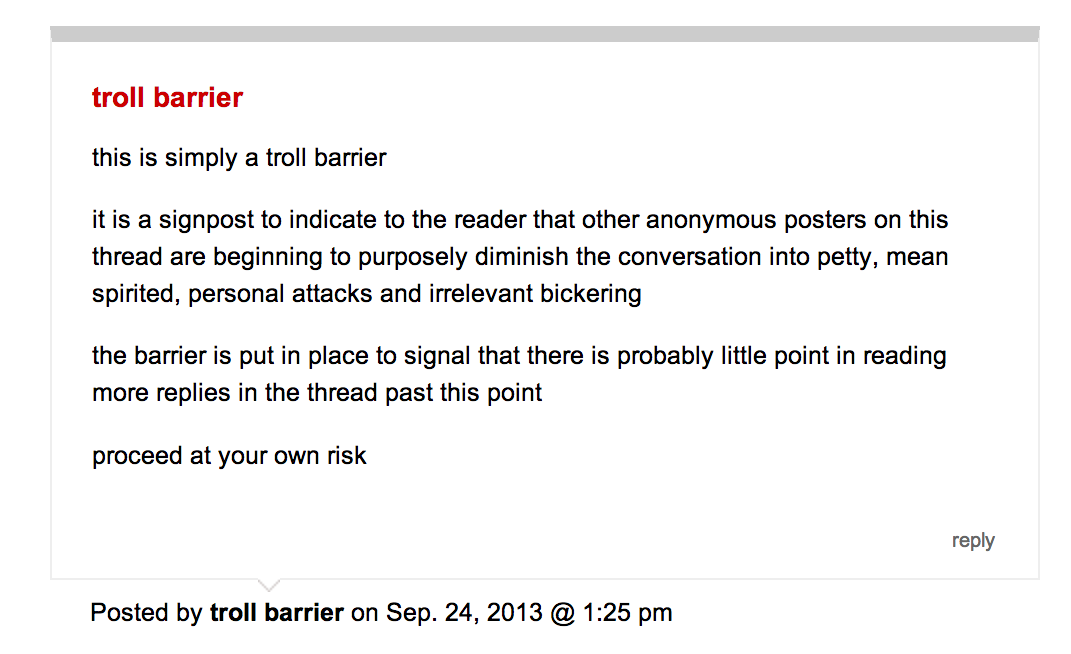
Screen_Shot_2013-09-27_at_3.10.01_PMIn response, commenter(s) are leaving “troll barriers” to point out comments deemed unacceptable. Unfortunately, since there isn’t an objective standard for what constitutes a troll, the short-sighted solution can resemble the behavior that it professes to resolve.

When an anonymous individual left a comment on an article about gentrification that expressed support for San Francisco’s changing demographics, it spawned a “troll barrier.” In response, someone using the handle “Chris” pointed out that merely expressing a disagreeable opinion does not constitute trolling.

“This is a discussion forum that the SFBG has chosen to open up to the general public, and posters will express a wide-range of views, some of which I will agree with and some of which I will not,” said Chris in his post. “I absolutely appreciate the idea that racial epithets, LGBT slurs, and other such comments have no place in a civilized public discussion, but comments that one simply disagrees with are simply part of having an open discussion about issues.”

Popular Science shut down its comments after concluding that they may be bad for science. While the suggestion may at first seem far-fetched, Online Content Director Suzanne LeBarre cited research that a field of hostile comments at the bottom of an article can polarize how readers feel about the subject matter of that article. Even “firmly worded (but not uncivil)” disagreements played out in comment threads can impact perception, said LeBarre.

“Because comments sections tend to be a grotesque reflection of the media culture surrounding them, the cynical work of undermining bedrock scientific doctrine is now being done beneath our own stories, within a website devoted to championing science,” said  LeBarre in a statement announcing the decision. “Commenters shape public opinion; public opinion shapes public policy; public policy shapes how and whether and what research gets funded–you start to see why we feel compelled to hit the “off” switch.”

At the Annette Strauss Institute for Civic Life at the University of Texas at Austin, Natalie Jomini Stroud is researching “techniques for engaging online audiences in commercially-viable and democratically-beneficial ways” as part of the Engaging News Project. The project published a report in June that looked at possible ways to mitigate comment incivility. The study looked at how a concluding question will impact the comments generated and also explored what happens when the reporter participates in the comments.

The experiment showed that although concluding with a question for reader may increase the amount of time spent on the page (the results were not statistically significant), it did not generate more comments. But, the research did show that “closed-ended questions, in particular, seem helpful for inspiring civil interactions.”

Some news outlets are attempting to improve civility by requiring people to register and use their own names, said the report. In evaluating the effects of journalist participation in comments, the researchers pulled the data from the Facebook page of a local television station. I imagine that one could expect similar results using Facebook’s Comments Box, which allows anyone to embed Facebook comments (which require an active Facebook account) on their own site.

“The chances of an uncivil comment declined by 15 percent when a reporter interacted in the comment section compared to when no one did so,” said the report. “When the station interacted, it had no effect on the incivility of comments. … It is possible that seeing a recognizable reporter from the news broadcast — as opposed to a generic station logo accompanying each comment — sparked additional civility.”

It looks like Google may soon offer its own way for sites to replace their existing comment systems to one with greater accountability.  The company is already changing the way YouTube handles comments, and If YouTube’s new approach to comments proves successful it may soon spread across the Web. With the new system, comments will no longer be shown in chronological order. Instead, they will feature better moderation capabilities to help people maintain civility on the comments for their submissions. Using Google+, comments from any friends or acquaintances will get top billing and be posted to the user’s Google+ page as well. Google+ comments are already available for people using Blogger, and there are even 3rd-party hacks to extend that functionality to other sites.

Of course this solution would require that visitors have an account with Google+, a similar problem to using Facebook comments, and there is no way to have any sort of verified account that doesn’t have the same hurdle.

One possible substitute — which I’ve never heard discussed in relationship to replacing comments — is a live video chat. Would strangers in an online room engage in civilized conversation if they can look each other in the eye?

If requiring real names can improve a forum’s civility, I’m sure seeing their real face would do even more to create an environment where meaningful conversation can flourish.
Home Page, JTM News

Journalism for Navigating Uncertainty: The Engagement Principle

Engagement increases respect, appreciation, and partnership between journalists and communities.

NewsEco-Journalism-as_croppedIn 1775, the American Revolution launched an experiment in engagement called “democracy”. That sparked a critical need for an informed public and ignited a mass literacy movement.
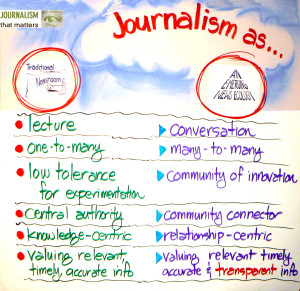
Today’s technological wonders are generating a “media literacy” movement that is fueling a new level of engagement. Journalism is no longer a one-way communication from journalist to audience. It is a conversation. News and information is created, published, curated, used, archived, influenced and more by anyone.  And many use social media to communicate and make meaning from news and information with friends, family, interest groups, and strangers.

As the founders knew when they shaped the First Amendment to guarantee free speech and a free press, engagement is essential to democracy and to vibrant community life. As Reynolds Journalism Institute Fellow, Mike Fancher, puts it, public trust grows through public engagement.

The Lawrence Journal World’s WellCommons.com, is a great example. Its chief architect, Jane Ellen Stevens invited the public to help define it.  According to Stevens, they set a goal to be the go-to place for news and information on health and wellbeing in the region. Half of the content comes from community members and half from professional reporters. The site has changed the community’s conversation about health and caused a more solutions-focused style of reporting.

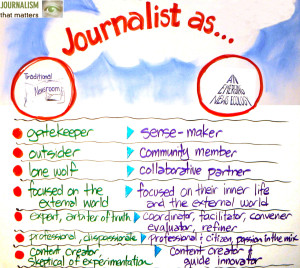
Like many other professions, journalists are renegotiating their roles and responsibilities as professionals. Among the new roles: community hosts, data wranglers, and beat bloggers. Consider some shifts in who provides content:

NewsEco-Journalist-as_croppedPersonal storytelling. Schools, libraries, and even journalism organizations are teaching skills to the public to help them discern quality, reliable content and to support people in creating their own stories. For example, through the “Living Textbook”, Arab American seventh graders learn journalism skills and tell stories about identity and how they see the world.
Community and organizational storytelling. With fewer professional journalists, communities and organizations are taking charge of their stories.  For example, the Colorado Health Foundation created the Colorado KaleidosCOpe, a “statewide storytelling campaign designed to shine a bright light on the good work of our grantee partners and the people whose lives they impact.”

Professional journalistic storytelling. Professionals still contextualize, deepen and amplify stories.  They can tell complex stories that take dedicated research and do the analysis and communication to help tackle tough subjects. They can help us make sense of the overwhelming amounts of information by showing us patterns and trends that shape society.

Because of these shifting roles and cultural changes, both journalists and the public they serve are asking a key question:

What is newsworthy? 

No longer solely controlled by journalists, how shall we –journalists and the public – discern what stories are critical for our communities and democracy? Journalists want to be relevant and trusted. The public wants important and trustworthy information. Imagine a full partnership: journalism of, by and for the people. That requires engagement.  The principles that follow speak to how to make that happen, where you are in the system.

Tips for Engaging

Whether online or in face-to-face conversations, some strategies to remember:

  • Invite the people who care about the issue, then welcome who and what shows up.
  • Ask real questions — meaningful ones for which you don’t know the answers and are genuinely curious.
  • Make it simple and easy to get involved. Consider accessibility. In person, handle parking and daycare.  Online, be crisp, brief, and able to participate with one click.
  • Make it fun. We’re more creative and collaborative when having a good time.  In person, have food.
  • Make space for individual expression and connection with others. We all crave to be authentic and to belong.  Support both.
  • Work in cycles. Offer context and a question. Invite a response.  Feedback or reflect together on what you learn, likely triggering another cycle.
  • Treat disruptors with compassion and respect while being firm and clear about appropriate behavior.  They likely have something important to contribute but lack the skills to communicate it.  Welcome the message while handling bad behavior.

Just as engagement is key for successful system change, diversity fuels innovation and a sense that we’re all in it together.  Stay tuned for more in the next post.

In the spirit of sparking engagement: enter a word or phrase on how you decide what is newsworthy in the comments below.

Got something to contribute?

A tip? An article? I’ve started gathering resources. Please add by

Unless you explicitly request otherwise, I will post comments sent via any of the above in the comment space below.

=======

Read the other posts in this series:

Illuminations Blog, JTM News

Engineering Chance Encounters in Online Spaces

The unifying factor among every great conference I’ve attended was the awesome people who participated and the amazing conversations I had with them. In rare cases these conversations were part of the conference itself, but more often generated spontaneously with a random encounter.

At this year’s National Conference for Media Reform in Denver, Colorado, my most memorable conversation happened about a mile away from the event itself and after all the sessions had concluded. I was killing time walking around the city while I waited for my flight, and so was he. That doesn’t happen in an online conference.

Journalism that Matters is exploring the possibilities of online communities and the potential for hosting its signature gatherings online. Last week we hosted an open board meeting using Google Hangout On-Air to discuss how JTM can continue to grow. This week a few of us participated in a conference call to discuss translating our unconferences for the virtual world.

When we asked the folks on the call what makes for a great conference, many of them expressed a conclusion similar to my own.

How do you create a space online to host a conference that seeds synchronistic meetings and catalyzes ad-hoc conversations?

One possible answer revealed itself during the call in the form of an awkward confession. After getting caught in a wave of multitasking, one of the people on the call (who will remain nameless) admitted their lapse and pointed out that this will be a significant issue in hosting a conference online.

It quickly became apparent that trying to stop participants from multitasking was not only impossible, but any attempts to keep people focused on the conference would probably not improve their experience. Instead, we decided it made more sense to embrace this tendency toward ADD by creating numerous side-channels that support both synchronous and asynchronous communication.

One idea was to create a sort of open board where people could anonymously share their reflections and thoughts about the ongoing conference. Someone else suggested the side-channel could function like a threaded bulletin board to help bring participants together around common interests. The topic of direct person-to-person communication didn’t come up, but that seems like an important step toward creating a space that resembles the halls outside a traditional conference.

While Google Hangouts On-Air provides a platform that allows up to 10 participants to see each other and communicate in real-time, there is still no way to easily bring other people “on-stage” to ask a question or make a comment. This might not be a problem for Open Space Technology gatherings, but the 10-person limit still poses a problem, especially as there isn’t a way to automatically generate a new hangout once the initial room reaches capacity.

By the end of the year, Journalism that Matters hopes to host its first multi-day online gathering. Our initial research and experiments have shown this is possible, but producing a conference online that’s as powerful as our previous gatherings is going to be difficult.

Please share what you think is necessary to successfully host a great conference online. And if you’d like to help us design something new and exciting please let us know.

Illuminations Blog, JTM News

The Weekly Illumination — Issue 5

Welcome to the The Weekly Illumination, a JTM newsletter offering a quick look at the week in journalism with a focus on what’s working in today’s news ecology. The Illumination is a curated collection of stories about journalism innovation, notable job opportunities, grants and updates about Journalism that Matters.

The newsletter is distributed to e-mail subscribers, through the JTM Google Group, and posted to the Illuminations blog. In this week’s Illumination we’ll highlight the news:re-wired digital journalism conference that just wrapped up, the business of community news sites and explore new opportunities in documentary film.

UK site hosts news:rewired conference

The news:rewired conference took place today at MSN’s UK headquarters. Journalism.co.uk hosted the one-day conference, which featured three different tracks: growing social media communities, mobile journalism, and open data for journalists. There are a wealth of resources available at the conference’s Web site, but two pages stood out as being particularly useful. In a session about turning data sets into maps, John Burn-Murdoch offers a solid introduction on the tools available to create data-rich maps. Another worthwhile post on the site provides a comprehensive list of tools to track and engage audiences over social media, which was pulled from the talk given by Richard Moynihan, Metro’s social media and community manager.

The challenge of moving conferences online

Journalism that Matters is exploring the possibilities within online communities and the potential for hosting its signature gatherings online. One of the most important elements of our all conferences is the opportunity to bring new people together who would otherwise never meet. In this week’s column, I look at how that magic can be created online.

Canada sells cable by the channel, so why can’t US?

Everyone with a cable television subscription in the United States has a list of channels they never watch. For some it’s sports, for others it’s cable news and still others have never bothered to find out what MTV is really about (hint: it’s no longer music television). Then there are those of us who would gladly subscribe to HBO if only we didn’t have to pay $60 a month for the 200 channels we don’t want.

To solve this first-world problem we turn to Canada where cable television is now being sold ala-carte. But the television industry doesn’t want to see this Canadian innovation imported to the States, reports Reuters.

The possibility principle

The third installment of JTM Board Member Peggy Holman’s ongoing series looks at what happens when stories focus on what’s possible instead of simply dwelling on what’s wrong.

“Possibility-oriented storytelling feeds a cultural narrative that helps us to navigate uncertainty by focusing attention on creative ways forward,” said Holman in her article. “Journalism can help us envision and move towards a world that works for all.”

Success of Homicide Watch D.C. leads to launch of new education news site

Three years after launching Homicide Watch, a landmark example of “structured journalism,” which seeks to bundle together narrative reporting, public data, and community submissions into a package made up of pieces that support others, Laura Amico has announced she is starting a new site focused on education. Her company, Glass Eye Media, is launching Leaning Lab to focus on K-12 education reform in Massachusetts.

“Learning Lab likely won’t look much like Homicide Watch, but the same principles — building foundational knowledge, creating tools for the community to interact with the reporting, and setting a space for community conversation at the center — will create the structure for meaningful coverage of Massachusetts’ significant education reform efforts,” said Amico in a post she wrote for Harvard’s Nieman Lab.

VICE expanding its video department

It started as a local Montreal publication almost 20 years ago; today VICE has grown into a multimillion dollar media business across all major mediums. The company has partnered with HBO for a documentary series and its You Tube channel has more than 3 million subscribers. At today’s news:rewired conference, Al Brown head of video at VICE UK said the company plans to focus on growing its video department.

“We’ve always been documentarians and journalists and our video journalism has been the most successful thing that we’ve done,” said Brown.

Visitors to the company’s YouTube channel average more than 25 minutes watching immersive videos produced by its reporters, which further demonstrates that online audiences are willing to sit through longer-form content.

But short-form webisodes will continue to dominate social media, and PBS Mediashift has a great article showing three ways for documentary filmmakers to use the medium to support their feature-length work.

The revenue that keeps community news sites alive

With the shuttering of dozens of Patch sites across the country, a lot of people have been questioning the viability of community news portals online. After all, if AOL’s deep pockets can’t keep a site afloat, is there any hope for the young entrepreneurial journalist or the veteran who refuses to put down his pen after the last buy-out sent him packing.

After Tech Crunch reported on Patch’s insufficient revenue — about $23.5 million a year — Street Fight’s Tom Grubisich decided to analyze that data and compare those numbers with the information he gleaned from speaking to a number of independent publishers on the Web.

Grubisich concluded that Patch’s average of less than $30,000 in revenue per site is abnormally low, and the publishers he spoke with conveyed a more optimistic perspective around possible revenue for community news sites. One publisher said that it a mature publication could generate about $1 per resident in the community per year; each of them indicated that their sites were generating significantly more than $30,000.

Gawker editor talks media ethics

“I do not think as a profession that reporters and editors need to think of themselves as bound by an additional set of conditions,” Gawker Editor John Cook told Toronto’s Globe and Mail (via Poynter). “I think the idea of building up a superstructure of journalism ethics is part of a process of trying to exclude the hoi polloi from the process of reporting and commenting on the news.”

Journalism that Matters strongly supports “journalism by the people.” How do the ethics of journalism affect how citizens participate in creating it? 

Job(s) of the Week

Do you want to be in charge of a newspaper? If you’re qualified and ready to move the Valley News is looking for an editor-in-chief for its newspapers in West Lebanon, New Hampshire as well as in White River Junction, Vermont.

For the past 75 years, the Nieman Foundation has offered one-year fellowships. Applications are now available.

Each week, The Illumination will include links to jobs, grants and fellowship opportunities. If you are hiring or know someone who is, send me an e-mail and I’ll gladly list it here. If you’re looking for a job, let me know what kind of work you are looking for and I’ll try to post anything I come across that could be a good fit.

Home Page, JTM News

Journalism for Navigating Uncertainty: The Possibility Principle

Journalism can help us envision and move towards a world that works for all.

Journalists have a unique role as storytellers, influencing the cultural narrative that weaves society together. Through my work in organizations, I know that when the stories people tell about the organization change, so does the culture.  The same holds true on the scale of a society.

JTMNW-Jan2010-Day4-1_Conf-Close-outcomes-cropPossibility-oriented stories generate new options. Research on the relationship between positive image and positive action by David Cooperrider, Case Western Reserve University professor of Social Entrepreneurship shows that we create what we can imagine.  Uncovering possibilities feeds our imagination, which is key to journalism that informs and also engages, inspires, and activates.

Though much of our current narrative is filled with stories that increase polarization, journalism educators and professional journalists are re-thinking dualistic — us versus them — models of storytelling.  Even investigative journalism, with its gotcha reputation, is increasingly including solutions.  InvestigateWest, a nonprofit investigative news organization born when the Seattle Post-Intelligencer closed, includes solutions as part of its approach.  Their groundbreaking story on the hazards of chemotherapy exposure for health care workers resulted in passing two laws improving worker safety in Washington state.  According to Rita Hibbard, executive director at the time, what made the difference were the possible solutions in the story.

This story demonstrates that even when the situation seems dire, other storylines are possible. In fact, conflict and struggle placed in a larger context become challenges to overcome rather than reasons to despair. They spark creativity and innovation.

Possibility-oriented storytelling brings journalism into the heart of community life, and supports a vibrant democracy. J-Lab executive director, Jan Schaffer, highlighted several examples in a Nieman Journalism Lab article.  Journalism That Matters gave the idea a practical twist by building on the traditional journalistic questions of who, what, when, where, why, and how, suggesting a sixth “w”: What’s possible now?

News organizations have emerged that are committed to a possibility-oriented perspective.  YES! Magazine has been at it since 1996.  Axiom News is of a similar age.  Both are growing. What’s Good 206 involves youth in telling stories of compassion and success.  David Bornstein’s weekly Fixes column in the New York Times explores solutions to major social problems.  And Bornstein’s newly formed Solutions Journalism Network is committed to rigorous and compelling reporting about responses to social problems.

Tips for Telling Possibility-oriented Stories

I offer a few pointers gathered from those who have been at it for a while:

  • Turn a problem into a possibility by asking: What might it look like if things were working?
  • Ask questions to discover the best of what is, to imagine what’s possible, to uncover ideas, and to spark action.
  • Cover what’s already happening to improve a situation.
  • Provide “handles” for audience to learn more or to get involved, for example, pointing to resources and organizations.
  • Report on new ways that are struggling to be born with the same attention and rigor as on what is dying.
  • Tell stories that present alternatives to dominant beliefs about “how things are”.
  • Turn victims into protagonists, for example, by following a story those affected make sense of their experience.
  • Make the system visible.  A vs. B stories miss the complexity of interactions involved.  Making nuances that transcend sides visible can bring about unlikely partnerships.
  • Invite audience to offer ideas about what they see as possible and what actions they will take to make it so.

Possibility-oriented storytelling feeds a cultural narrative that helps us to navigate uncertainty by focusing attention on creative ways forward.  Another critical complement for equipping us to be free and self-governing rests in engaging the diversity of people who care about an issue. The next post sheds some light on engagement.

Got something to contribute?

A tip? An article? I’ve started gathering resources. Please add by

Unless you explicitly request otherwise, I will post comments sent via any of the above in the comment space on this page.

Follow up on last week’s post, An Expanded Purpose for Journalism

Email was still the primary vehicle of choice for responding, though Facebook also brought some comments.  Jane Stevens, Founder, editor of ACEsTooHigh.com, offered the example of WellCommons, Lawrence Journal-World’s local social journalism health site.  I’ll be saying more about the award-winning WellCommons in the next post in this series.  So stay tuned!

=======