Illuminations Blog, JTM News

An interview with Dan Gillmor

danmug-150x150Dan Gillmor is a recognizable name and face in the emerging news ecology who teaches digital media literacy and digital media entrepreneurship at the Walter Cronkite School of Journalism at Arizona State University.

He’s attended several JTM gatherings, including the JTM News Tools event in the Silicon Valley.

Gillmor’s 2004 book We the Media: Grassroots Journalism by the People, for the People was described as “something of a bible for those who believe the online medium will change journalism for the better,” by the the Financial Times. In 2010, Gillmor published Mediactive, a guidebook for improving digital media literacy. His next book, will look at “the increasing control that companies and governments are exerting over the way we use technology and communicate, and how we can take back some of that control.”

I recently had a chance to talk with Gillmor over the phone and have highlighted some of the things he said during our conversation.

On what’s working:

I think it’s great that there are so many experiments, but it’s hard for me to point to any one in particular and say this is especially of note. There are a lot of terrific things going on out in the community. Mainly I’ve seen a lot of experiments, which is what I’m hoping to see: people trying lots of different things.

On what’s missing:

One of the things that I still think needs to be done — and I haven’t seen anyone do it — is to really put together a team to figure out what’s going on outside of the journalism world that could have application to the journalism world. I constantly run across stuff in fields that don’t appear to have any connection at all to journalism where it seems to me there would be pretty interesting possibilities if a technology or a technique were applied to a journalism space.

It just feels to me like there’s a lot of people going past each other or not even finding out about each other, which is often the case.

There’s not enough thinking about how the things that are being invented by non-journalists might be used by journalists. The cross fertilization that goes on in some of these hack days is a great start, but it’s just not to the degree that I’d like to see.

On the future of advertising: 

As other people have said in the past few years, there’s no obvious connection between a local department store and journalism. It’s been a coincidence of economic history that that has been the case, but it doesn’t mean people shouldn’t try, of course they should.

It also means that advertising itself has a future, and I’m not convinced. There will be some future for it, but I’m pretty skeptical about advertising — as it currently exists — being a substantial media phenomenon for a lot of reasons. It’s just not something that makes a lot of sense, unless you have a monopoly, and that’s gone.

On Jeff Bezos purchase of the Washington Post and Pierre Omidyar’s new news initiative: 

I’ll say it again and again, I’m thrilled that they are doing it.

What’s great about what they’re all doing is that they’re going to experiment and there’s not been nearly enough of that in the traditional business, so I can’t wait to see what they do.

But I don’t think we should oversell to ourselves what’s going to be the likely outcome — given that the money they are going to spend is going to be in the category of rounding error for them. It is a lot for journalism and that’s why I’m excited about it, but we shouldn’t imagine that it’s more than it is.

On Twitter:

The most conversation going on at the moment starts on Twitter. It doesn’t end there, and people do take it elsewhere for more depth.

I think it’s both good and a little scary that they’re locking up the conversation, and that they are a place where so much of this starts. It’s a platform issue, I’m not crazy about a centralized platform that journalists don’t control themselves being the place where they have their conversations with audiences. I think that’s dangerous, but having said that I’m glad that it’s going on.

On news organizations using Facebook for comments:

I think news organizations that have farmed their comments to Facebook are mind-boggling shortsighted. It’s not a matter of real names. It’s a matter of real moderation and putting in the work it takes to have a space where people can have good conversations. What news organizations have said is, “we couldn’t be bothered to do it right, so we’re just going to let our biggest competitor take over.”

I don’t have any particular evidence that the conversations get all that much better by putting them on Facebook. There’s a lot of trolling going on there.

If a news organization cared enough it could have an online conversation going on that was not a rancid pool of toxic waste the way that some of them are. It’s not impossible to do.

It’s moderation, and I use that word in several ways, but moderation matters. The news organizations that have given up have basically said to themselves and to their audiences, “we couldn’t be bothered to run a place where people behaved like human beings. We couldn’t be bothered so we’re going to outsource it.”

I think a lot of them have made a conscious tradeoff understanding that they’re giving something significant up to do it. All I’m saying is I think it’s stupid. I think it’s a big big mistake.

On Disqus:

It’s a well-done product, but there’s value in the conversations beyond having them. If you’re thinking about a business and handing that over to people who are becoming or already are competitors, it just strikes me as lunacy. But that’s what’s going on.

I don’t think it’s so hot that people want to use this data to data-mine their customers and turn them into the product — which is a lot of what goes on — but to have no control whatever seems, again, the word I keep coming up with is shortsighted.

Postscript:

Gillmor has been celebrating the explosion of journalism experiments for nearly a decade. While the economic outlook for journalism looks better today than it did a few years ago, the fact that Gillmor couldn’t immediately point to any exemplars shows that it will take more than ad-hoc experiments alone to escape this ongoing crisis of journalism.

I was a bit surprised to learn of Gillmor’s perspective on the Facebook comment platform. He’s right about the value in conversations, but I’m not convinced that attaching real names to comments doesn’t inhibit trolling to some degree. There are some particularly vile things people will usually only say anonymously.

Finally, I really liked Gillmor’s suggestion to look toward successes in other industries to find lessons for journalism, and we plan to expand the Illuminations Blog in that direction soon. 

Josh Wolf
Editor-at-large

Correction: This article has been edited for clarity since its first publication.
Illuminations Blog, JTM News

The Weekly Illumination — Issue 8

Welcome to the the Weekly Illumination, a JTM newsletter offering a quick look at the week in journalism with a focus on what’s working in today’s news ecology. In this week’s Illumination we’ll examine the just-announced media organization from Pierre Omidyar, the founder of E-bay. We’ll also take a look at the challenges facing news startups, and how journalism intersects with Twitter.

X marks the spot

Maps have proven useful for getting around unfamiliar cities — even finding hidden treasure — but we can also learn about complex systems by mapping how the parts fit together. In the final piece of her series on the emerging news and information ecosystem, Board member Peggy Holman looks at how mapping the news and information ecosystem can reveal new opportunities.

New news project from tech titan

In what is hopefully becoming a trend, E-bay’s billionaire founder announced this week that he’s teamed up with Glen Greenwald to launch a news Web site with offices in New York, Washington DC and San Francisco. Pierre Omidyar already owns the Honolulu Civil Beat, which he launched in 2010, so the move isn’t entirely uncharted territory.

Adrienne LaFrance worked for the Civil Beat before joining the Nieman Lab where she shared her insights from the experience.

Last month The Illuminations blog wrote about how Jeff Bezos will bring with him a culture of experimentation with him to the Washington Post. And this week Jack Shafer at Reuters explored why billionaires are once-again drawn toward owning their own publications; USA Today’s Rem Rieder remains skeptical but hopeful.

Atwitter for Twitter

It seems like just about everyone uses Twitter these days, but if the company is going to prove profitable, just about everyone will need to include more than the 200 million people around the world using it today. As part of this process, the company is investing deeper in news and is poised to hire Vivian Schiller, who previously ran NPR, to head up the department.

Scores of journalists are already Tweeting of course, but for those just getting into the platform Twitter’s Erica Anderson shared five helpful tips for reporters at Mediashift.

Nate Silver and Ariana Huffington say no to paywalls

There’s been an influx of permeable paywalls following the model set by the New York Times, but this week Nate Silver of the ESPN-owned property FiveThirtyEight.com said that the new site will be free. In an unrelated interview Ariana Huffington told memeburn.com that The Huffington Post has no plans to adopt a paywall and that doing so would dramatically eat into the company’s advertising revenues.

Got advertising?

Advertising dollars spent on journalism have been drying out for more than a decade, but companies like Google Facebook and Twitter are flush with advertising revenue. In this week’s Illumination, I look at how news organizations can reclaim some of this lost fortune.

Keeping your startup from shutting down

Media incubator Matter, which we wrote about previously, announced their new class of startups. Matter will invest $50,000 and three months of guidance to help these fledgling companies succeed, but as Poynter’s Sandra Oshiro points out 90% of startups will fail. Oshiro has prepared a list of five myths that can stop startups that may at first seem a bit discouraging but are important for any entrepreneur to keep in mind. Kelsey Mallahan at Mediashift has prepared her own version of a crash-guide for new startups, which urges new businesses to begin by identifying their goals, their audience and where they will generate revenue.

Odds & Ends and Odd Ends

Job(s) of the week

Work from home or the organizations midtown Manhattan office, Remapping Debate is now hiring a Creative Journalism Fellow. The position pays between $40 and $60k, depending on experience and includes paid vacation and health insurance.

JTM is looking for freelancers to write about successful journalism initiatives and is paying up to $250 per story.

For the past 75 years, the Nieman Foundation has offered one-year fellowships. Applications are still available.

***

The Illumination is a curated collection of stories about journalism innovation, notable job opportunities, grants and updates about Journalism that Matters. It is distributed to e-mail subscribers, through the JTM Google Group, and posted to the Illuminations blog.

Illuminations Blog, JTM News

Got Advertising?

With rare exceptions, advertising is the lifeblood of a sustainable news enterprise. When reduced to its simplest terms, a news outlet’s business model can be broken down to selling advertisers access to an audience.

This is the same business model that catapulted Google to become one of the most profitable companies on the planet, and it is the same business model that is now affording Facebook financial success and made the upcoming Twitter IPO possible.

If advertising is generating billions of dollars for these online ventures, why is the news business in such dire straits and starving for revenue? While it may not be feasible for a single news organization to bring in the $950 million of advertising revenues that Twitter projects for the upcoming year, there remains an opportunity for both the established and emerging news industry to reclaim more of those advertising dollars that once kept newsrooms filled with reporters.

Throughout the journalism community there is a near consensus that the future of journalism depends on sources of revenue outside advertising. Last year, when the Tow Center Center for Digital Journalism released its report, Post-Industrial Journalism: Adapting to the Present, Journalism in the Americas reported it on their Web site with this headline: The ad-based journalism industry is dead, says Columbia University in new essay.

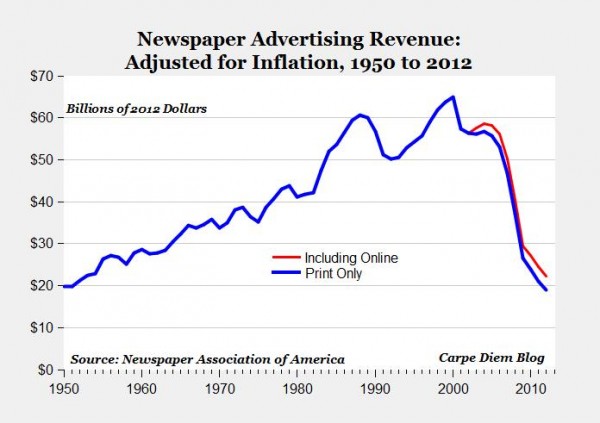
adrevenue-600x423The amount of money spent in newspaper advertising grew steadily throughout the 20th century, peaking around the year 2000 with nearly $65 billion in annual revenue. It has sharply declined ever since. By 2012, the total revenue across the industry had plummeted to $18.9 billion, according to the Newspaper Association of America.

The decline of advertising does chart the growth of Craigslist, which went online in 1996 but didn’t expand to other cities until the summer of 2000. While it’s possible that newspapers had an opportunity to generate some revenue by launching their own free classifieds marketplace before Craig Newmark arrived, the nature of the internet and online bulletin boards all but ensured the death of revenue through classified ads.

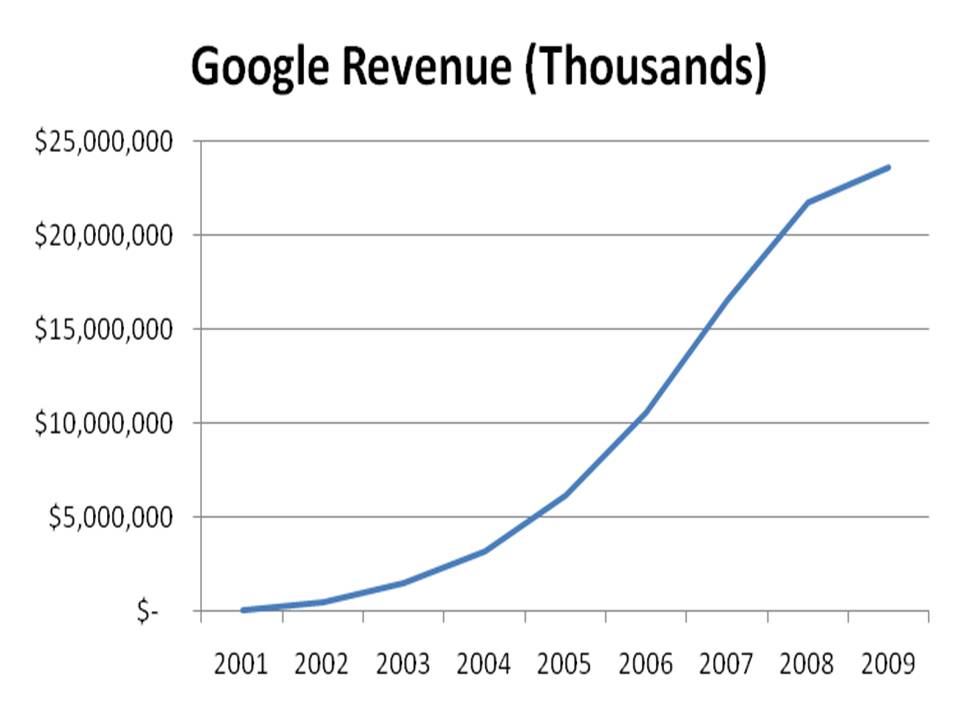
google-revenue1The year 2000 was also when Google began selling advertising, something that its founders had decreed as “inherently biased toward the advertisers and away from the needs of the consumers,” in an academic paper the duo had written two years earlier. But by 2006, the company reported nearly $10.5 billion in advertising revenue, and even today the vast majority of the company’s $50 billion in annual revenue comes from advertising.

It would not be wise for a news organization to compete against Google with its own search engine, and I don’t think any have tried. But not all of that advertising is displayed alongside search results. Thousands of Web sites are sharing advertising revenue with Google by using Adsense to serve up ads all over the web; YouTube advertising works in a similar fashion.

Though it’s probably too late for the news industry to translate its long-standing relationships with advertisers into an advertising network comparable to Adsense, there remains opportunities for advertising deals that can provide media organizations stronger revenue than the 68% share offered by AdSense.

Facebook launched in 2004, but the site didn’t open it’s doors to the general public until September 2006. Last year the company reported $5 billion in revenue and about 85% of that money comes from advertising. While Facebook has struggled to generate the advertising necessary to maintain a healthy profit and demonstrated its performance on the stock market following the company’s IPO last year. The stock lost a quarter of it’s starting value within a month of going public, but it has been gaining ground over the last few months as advertising revenue has improved.

Have you started seeing Facebook posts in your Timeline that only revealed themselves to be sponsored content after careful inspection? While Facebook ads once lived off to the right side of the screen where you could safely ignore them, the company has since embedded them into the Timeline in such a way that the only giveaway that the post wasn’t shared by your friend are the “suggested post” at the top and “sponsored” printed underneath in a subtle gray.

By creating an advertising product that seamlessly blends with the rest of the content, Facebook has finally developed a new way to sell companies access to its growing audience. The site also encourages its users to like commercial endeavors including movies, music and even companies that can harness this network to deliver a more personalized — and monetarily valuable — experience.

Not only that, but the company also offers another way to give their advertising clients better access through Facebook Exchange. The service allows advertisers to monitor your activities on the Web so that it can deliver advertising for products you were already looking at. Though the first time I noticed an advertisement for something I had just been reading about, it felt like kismet and that’s exactly why the service is appealing to advertisers.

Now Twitter is readying its own IPO and is expending tremendous resources to find a way to generate enough revenue to satisfy investors. Twitter is projecting $900 million in revenue for 2014, but even after generating $422.2 million in revenue during the first nine months of this year, the company still lost a total of $133.8 million. Still, if it can follow the trajectory of Facebook and Google before that, the company stands to begin making a profit soon.

There are many things that differentiate these three companies from all content-creating news organizations; the first, obviously being the creation of original content. Since Google, Facebook and Twitter are each content aggregators as well as platforms for user-generated content, the companies avoid most of the expenses of hiring an editorial department.

Because there are no established ethical boundaries prescribing how advertising should function in this emerging form of media, approaches that blur the lines between content and advertising are sometimes embraced. These new forms of advertising raise ethical questions around privacy and disclosure, but they also work to convert sales and are generating significant revenue. Revenue that news organizations may need to stay alive as other advertising revenue continues to diminish.

Following the path carved by Buzzfeed and other digital upstarts, traditional media is increasingly turning to sponsored content to generate revenue, concluded a July report by Edelman, a PR firm. But the increased revenue can have its price, as an embarrassed Atlantic learned when it ran unwise sponsored content provided by the Church of Scientology back in January.

For Adage, Michael Sebastian reports:

For marketers, the appeal is simple: Audiences understand that advertisers have a commercial relationship with a publisher. By wrapping ad messages in a format that looks like editorial content—and calling them something else, such as “sponsored” or “partner” content—they hope to trade on the trust and goodwill editorial has built up with the audience. A bit of confusion is inherent in the appeal.

It’s a tricky trade-off. Publishers would like to see some of that $1.9 billion such ads bring in, but should be concerned about what advertising’s encroachment means for their brands. Already ads have jumped from the right rail into news streams. So-called native ads commonly mimic headline and editorial styles and fonts. Some publications go so far as to enlist their writers to create sponsored posts for advertisers to ensure the right editorial tone is struck. BuzzFeed offers courses to media agencies on its particular brand of storytelling. The line between advertising and editorial is getting really blurry.

Guidance could be on the way, though. Last week the Federal Trade Commission said it would hold a workshop on native advertising in December. The agency wants a better understanding of best practices and whether consumers are able to recognize sponsored content as advertising.

Until there’s a standard for what goes too far, publishers are leaning on their own version of the famous Supreme Court measure for obscenity: “I know it when I see it.” Occasional blunders are inevitable since even the best gut instincts have off days — and the ultimate risk is that such moves result in an outcome that’s bad not just for publishers but marketers, too: jaded, distrusting consumers.

Sponsored content doesn’t have to be pernicious. I have a friend who writes advertorial content at the LA Times, and the work he produces is very similar to the work he did covering arts and entertainment for an alternative weekly in the midwest. Although the events he writes are paying directly for the story, it’s not that different than when the event is paying for a full-page ad adjacent to the story about said event.

Although sponsored content may supplant some of the lost revenue, there remains the question of scale. Most news organizations are local in nature and thus serve a limited audience, while advertising only becomes profitable when scaled to reach enough people.

There have been efforts to create advertising networks to address this challenge, but none of them have demonstrated widespread sustained success. The fact that competing corporations are legally prohibited under antitrust laws from working together to solve the problem is just one of many factors preventing its realization.

But there is one company uniquely situated to build such an ad network. The Associated Press is a cooperative business owned by its member news organizations. Although the AP hasn’t exactly entered the advertising business, the company did sell sponsored tweets during the Las Vegas Consumer Electronics Show in January.

If the AP were to build its own advertising network, the members that would have the most to gain would be the smaller news outlets that don’t have their online sales team and the traffic to attract national corporations with bigger budgets. And it seems unlikely that these members would have enough clout to catalyze such an endeavor.

Advertising is certainly not the sole solution to this crisis in journalism. As long as the news is filled with natural disasters, crime and crooked politicians, advertising will continue to be a tougher sale than smiling cat videos and pictures of people’s children on Facebook, and even inspiring stories about solving problems of homelessness, crime or poverty will never be as attractive to advertisers as stories about real estate and entertainment. Still, despite the frustrating decline that has left so many news professionals worried about the sustainability of professional journalism, its far too early to completely dismiss advertising.

Home Page, JTM News

Mapping the News and Information Ecosystem

Envisioning what the news and information ecosystem looks like contributes to creating it.

Understanding a complex system is no easy task. Maps simplify reality to highlight useful distinctions. They give form to an abstract idea, like a news and information ecosystem. Just as nature’s ecosystem is a community of living organisms — plants, animals and microbes — interacting with nonliving components in their environment — air, water and soil, a news and information ecosystem consists of the interactions among its organisms — journalists, the public, journalism educators, media reformers, and others — in their environment — organizations, associations, the Internet, mobile devices.

Whether natural systems or social systems, mapping makes visible nonlinear, complex relationships. Think of the many maps of the human body from science class: circulatory system, nervous system, muscular system and others.  Communication becomes easier because of a common framework.  Consider the breakthroughs attributed to mapping the human genome. Health care providers have an increased capacity to treat, prevent and cure disease.  New technologies for sharing information and working with it are also among the benefits.

Imagine a comparable set of maps of the news and information ecosystem. They could help us to pursue questions like:

  • Where are innovations happening?
  • Where are opportunities for new ideas?
  • Who’s funding what aspects of the system? And what needs funding?
  • What’s missing? What else needs to be visible on the map?

Different kinds of maps help us understand different aspects of a system.  They can be used for understanding what to measure.  As noted in the Knight Commission report on the news and information needs of communities, “If activists, policymakers, and the general public had more concrete ways of describing, measuring and comparing the systems of community news and information flow, it would be much easier to mobilize public interest around community information needs.”

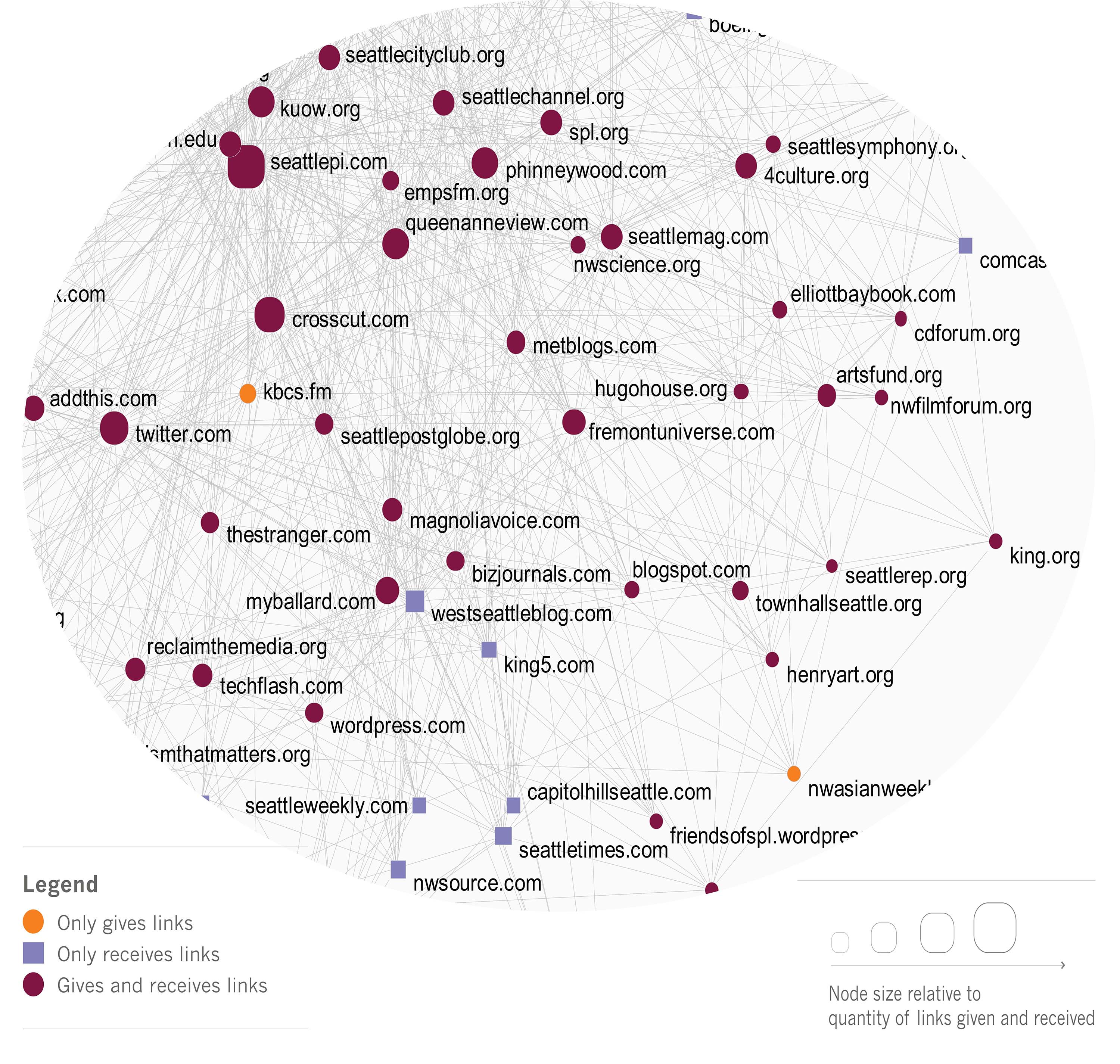
One news executive experienced the practical benefits of mapping when he saw a network map (one segment below) created for the 2010 JTM Pacific Northwest conference.  He noticed the competition near the center. His organization was off to the side. A colleague explained antiquated technology caused the problem. Shortly after the conference, that technology changed.

Seattle_Extended_Network_Fragment_med_res.jpg

Thanks to Richard Rogers, director of Govcom.org Foundation, Amsterdam for creating the map.

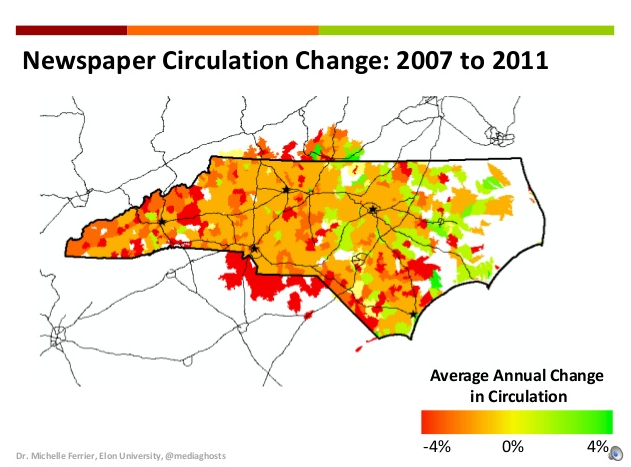
Dr. Michelle Ferrier, Associate Dean for Innovation at Ohio University’s Scripps College of Communication (and JTM board member), is creating geographic maps of media deserts. By mapping places where fresh news and information is lacking, these maps identify where resources are most needed.  Her proof of concept used North Carolina.  One of the series is pictured here.

Screen_Shot_2013-10-15_at_1.51.36_PM.png

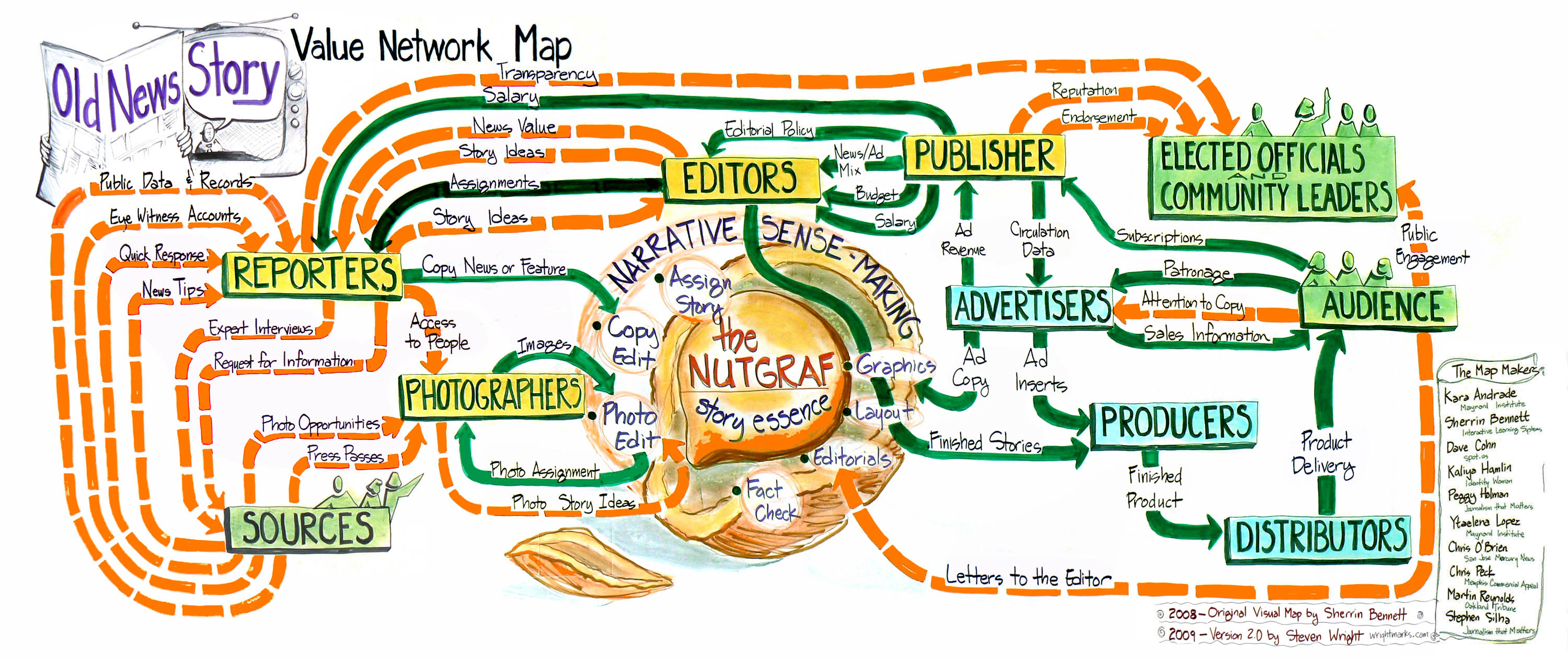
In 2008, JTM created its much copied value network maps of the old and emerging news and information ecosystems.  (Visit the link for the emerging ecosystem map.)

old-to-present-v3-letter_darkened-med_res.jpg

Value Network Maps are a terrific approach for understanding the interactions of a complex system.  They help identify opportunities for partnerships, innovation, development, and much more.

Much has happened since that 2008 map making session.  Were we to map what’s emerging today by focusing on possibility, engagement, and diversity, we could chart pioneering territory, making visible opportunities for further advances and wider adoption.

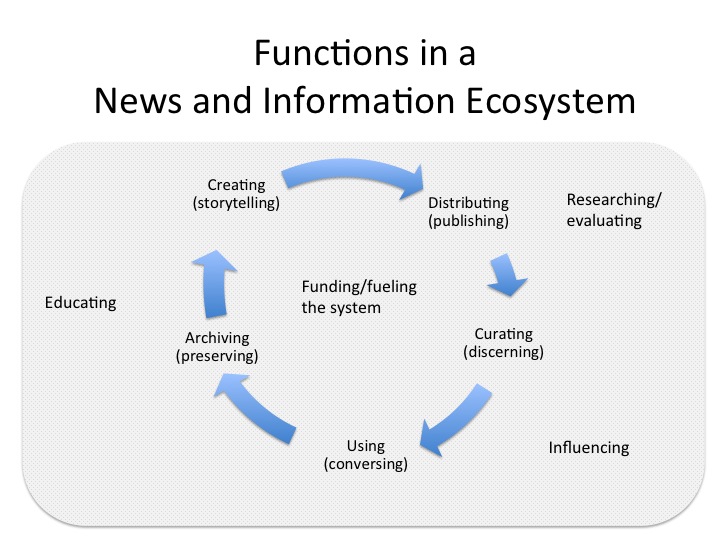
As a start, I offer a simple functional map of a news and information ecosystem, along with a preliminary list of agents. Far from complete, it gives a glimpse into what is emerging.

Slide2.jpg

Roles in a News and Information Ecosystem

Content Creators/Storytellers

  • Reporters
    • Professional
    • Amateur
    • Community
    • Organizational (business, nonprofit)
    • Investigators
    • Long form narrative writers
    • Short form narrative writers
    • Editorial writers
    • Beat reporters
    • Bloggers
    • Data handlers

Publishers/distributors

  • Print
  • Broadcast
    • Radio
      • Traditional
      • Low power FM
      • Satellite
      • Internet
    • TV
  • Online
    • Social media
    • Blogs
    • Emerging forms
      • Games
      • Hip hop
      • Comedy
  • Other dimensions
    • Public/private
    • Large/small
    • Geographic/topical


Sense-Makers/Discerners

  • Curators
  • Aggregators
  • Fact checkers
  • Transparency advocates


Users/Communities

  • General Public
  • Supporters
    • Community stewards/ navigators/ombudsmen
    • Media Reformers
    • Community organizers
    • Librarians


Archivers

  • Librarians
  • Others?


Researchers/Evaluators

  • Academics
  • Librarians
  • Historians
  • Evaluators


Influencers

  • Government
  • Business
  • Media Advocates
  • Educators
  • Ethicists – people who bring important questions like:
    • What is newsworthy?
    • What lenses serve our storytelling?
    • Who tells our stories?
    • What are the roles of the system and how can they best serve the needs of communities and democracy?
    • How do we reach everyone?
    • What is advocacy?


Funders

  • Advertisers
  • Foundations
  • Public – Fees for service, products
  • Venture capitalists
  • Angel investors
  • Others?


Educators

  • Teachers
  • Students
  • For the public – Media literacy organizations
  • For the story tellers
  • Topics
    • Craft
    • Ethics
    • Technology
    • Analysis
    • Investigation
    • Engagement
    • Systems Thinking and Change
    • News Judgment – choosing stories
    • Entrepreneurship
    • Media law


You can help make it better. What roles, functions, and connections do you see in the ecosystem? The clearer the picture of what we want to create, the greater our ability to realize it.

I end my series on journalism in changing times with a challenge. We are in a pioneering era in which the mental maps that guide us are being redrawn. Not just in journalism, but also in education, health care, governance, and every social system. No matter where you are, learn to navigate uncertainty.  Look for possibilities, engage others, and welcome the creative potential diversity brings. Tell your stories, map new terrain. Make a difference wherever you are.


***********

Got something to contribute?

Unless you explicitly request otherwise, I will post comments received from all media in the comment space below.

=======

Read the other posts in this series:

The Possibility Principle

The Engagement Principle

The Diversity Principle

Illuminations Blog, JTM News

The Weekly Illumination — Issue 7

Welcome to the the Weekly Illumination, a JTM newsletter offering a quick look at the week in journalism with a focus on what’s working in today’s news ecology. In this week’s Illumination we’ll look at how the role of the television in people’s homes is changing, explore how increased awareness of public surveillance is affecting journalism, and highlight two new sites created by established media companies.

Journalism that Matters announces call-out for submissions

Do you know of a news site or publication that’s doing something that others should follow? You could earn up to $250 by sharing their story on the Illuminations Blog. The Illuminations Project is built around highlighting these sorts of solutions, and we’ve announced a call-out for submissions showcasing as many of these success stories as possible.

Most Americans get their news from the TV, but many millennials avoid television

A new Pew study shows that even in 2013, more Americans get their news from television than online or print sources, but research from the New York Times shows that one-third of millennials watch little or no TV, reports Andrew Beaujon at Poynter. It’s not clear from these two studies whether young adults are consuming less news than their older counterparts, but it’s clear that a smaller portion of people will be getting their news from TV as the population shifts over time. Seeing this threat, John Malone, a leading executive in the cable industry, is calling for companies across the industry to develop a single national brand to stream content over the internet and compete against Netflix.

Project Censored’s 2014 compendium is available now

The latest edition of Project Censored’s annual volume of the most under-covered stories of the year is now available at your local bookstore and online. In this week’s Illumination’s blog we look at how the nonprofit organization has sustained itself for more than 35 years.

Get involved in the changing news and information ecosystem

JTM Board Member Peggy Holman’s series on the emerging information ecosystem continues with a look at the importance of diversity in voice, form and funding. In her latest column she explores the role you can play in improving our media landscape.

Dispatch from international gathering of news councils

JTM Alum John Hamer recently returned from the 15th annual meeting of Alliance of Independent Press Councils of Europe. Hamer is the president of the Washington News Council, the only group of it’s kind in the US, and filed this report from the meeting.

There are no anonymous sources without anonymonity

“At the present time, the NSA has made private electronic communication essentially impossible,” said scholars and journalists from the MIT Center for Civic Media and Columbia Journalism School in a 15-page comment to the group President Obama convened following the NSA revelations. “What the NSA is doing is incompatible with the existing law and policy protecting the confidentiality of journalist-­‐source communications. This is not merely an incompatibility in spirit, but a series of specific and serious discrepancies between the activities of the intelligence community and existing law, policy, and practice in the rest of the government. Further, the climate of secrecy around mass surveillance activities is itself actively harmful to journalism, as sources cannot know when they might be monitored, or how intercepted information might be used against them.”

The Committee to Protect Journalists released its own report this week detailing how the Obama administration has contributed to this climate by aggressively pursuing leaks and the changing relationship between the government and the press in the decade following 9/11.

Does the future of the Washington Post look like Pinterest?

Ezra Klein, the publisher of the Washington Post’s Wonkblog has unleashed a new portal to that looks surprisingly like Pinterest. Know More consists of a series of boxes dominated by images with headlines underneath. Clicking on a box expands the image, and in some cases reveals an animated gif, and an opportunity to “know more.” The Nieman Journalism Lab spoke with Klein about the new site.

***

The people behind the Pulitzer winning fact-checking site PolitiFact, which fact checks elected officials, have announced their new site PunditFact will apply the same methodology to verify the statements made by pundits and other media personalities.

JTM named as one of the 105 vital sources for journalists

Journalismdegree.org released a guide to “the new media landscape” that includes “105 vital sources,” and JTM made the list. For anyone interested in the changing news ecology, this list is sure to yield some gems you haven’t seen before.

Job(s) of the Week

Yes! is looking for an Executive Editor.

For the past 75 years, the Nieman Foundation has offered one-year fellowships. Applications are still available.

***

The Illumination is a curated collection of stories about journalism innovation, notable job opportunities, grants and updates about Journalism that Matters. It is distributed to e-mail subscribers, through the JTM Google Group, and posted to the Illuminations blog.